
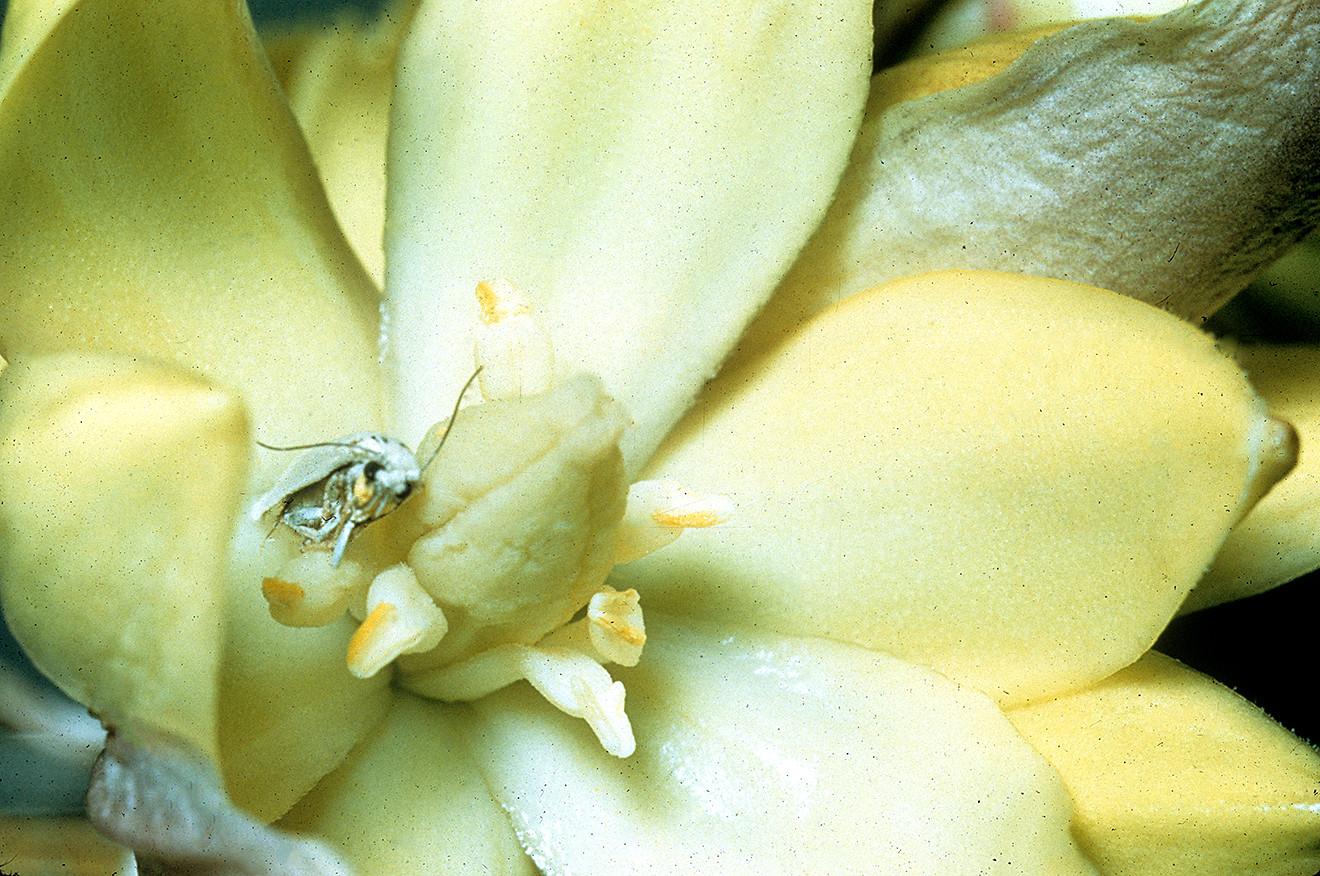
The yucca moth doesn’t look like much, a nondescript white flitter you probably wouldn’t notice. But the four species of this moth have a much more interesting destiny than hanging around your closet nibbling on your jacket. In what biologists call a “mutualism,” the moth and the desert plant it’s named for have a beneficial — indeed, absolutely necessary — relationship.
According to the U.S. Forest Service, adult yucca moths don’t eat — they apparently don’t live long enough to get hungry. So they don’t have the long snout and nectar-grabbing tongue you find on other moths. Instead, they have face tentacles, which, after mating, the female uses to roll up and carry a ball of yucca pollen. She carries the ball to another yucca, lays eggs, and leaves the pollen — which the plant uses to create seeds. (The “other yucca” part is important; the moths ensure the vitality of the yucca species by cross-pollinating them.) When the larvae hatch, they eat some, but not all of, the seeds, and the cycle begins again.
In this mutualism, each participant is wholly dependent on the other. As the Encyclopedia Britannica puts it: “The yucca can be fertilized by no other insect, and the moth can use no other plant.”