
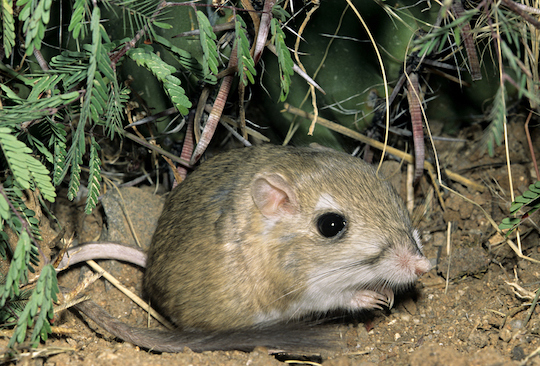
“Everything eats kangaroo rats,” says BirdAndHike.com. Owls, snakes, foxes, coyotes, bobcats. The fact that it’s welcome on so many menus structures the kangaroo rat’s existence in many respects. It lives in burrows with multiple openings, so there’s always one nearby; it’s been theorized that the rats dig those entrances at a shallow angle so they don’t have to slow down until they’re inside. They’re nocturnal, but they limit their activities during full moons, when they're more visible. And they have getaway hops: They can jump a foot or two straight up, and as much as 7-9 feet as they flee on their back feet at upwards of 6 mph.
I can testify to their agility. A few years ago one of these little dudes infiltrated our house for a 48-hour period that began with my daughter-in-law screaming in the kitchen and ended with two grown men using sheets of cardboard to direct the rat toward the front door, whereupon another grown man used a broom to roll it outside. (It hopped away unhurt.) In between there were several ineffective capture attempts, including (cringe!) a box tilted up on a stick over a pile of food, with me eight feet away ready to pull the string. 🪤 <— Exactly like this. Regrettably, I am not making it up.
The rat was too smart for that, however.
Merriam's Kangaroo Rat
Sciencey name: Dipodomys merriami
Size: The body is usually 2-4 inches, the tail 5-6.
Fun fact: Like the marsupial it’s named for, the kangaroo has a pouch — for carrying seeds, however, not offspring.