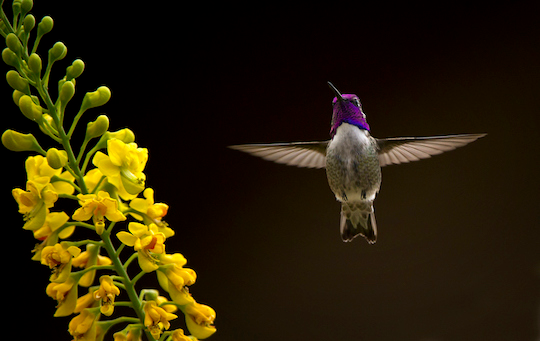
They are tiny, adorable eating machines. Hummingbirds are reputed to have the highest metabolism of any warm-blooded creature other than infomercial pitchmen — and that requires a lot of fuel, between three and seven calories a day. Doesn’t sound like much? It’s equivalent to about 155,000 calories a day for us; a mealless gap of just a few hours could prove fatal. (To sleep they downshift into a state called torpor, in which their heartbeat slows and their body temp drops as much as 50 degrees.)
This nonstop consumption is made possible by some advanced mechanics. For instance, to hover or fly backward or sideways, they beat their wings 10-80 times a second, depending on species. But there’s more to it than speed. They flap in a kind of oar-rowing motion, generating lift on both the up- and downbeat. Wind-tunnel tests show they maintain their hover in wind and rain, too.
Hummingbirds also seem perfectly engineered for humans to adore: as avatars of beauty, just in time for spring (🎧); as zippy symbols of nature’s clockwork intricacy; as metaphors for our flitting attention spans; as prompts for mediocre Leonard Cohen songs. And poets really seem to love them. Charles Wright, for example: “Give me the hummingbird, who has to eat sixty times / His own weight a day just to stay alive. / Now that's a life on the edge.”