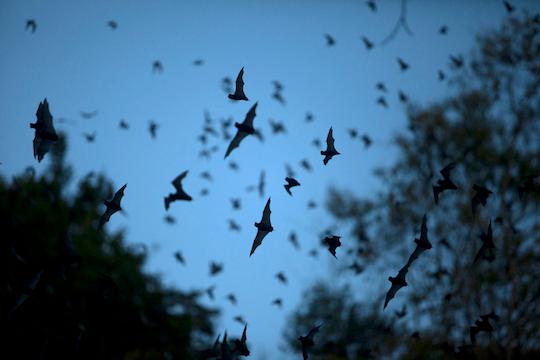
Pity the poor bat: All it wants to do is flit around inhaling insects and reveling in its status as the world’s only flying mammal, yet it’s permanently encased in gothic mythology — associations with vampirism, baseless allegations of rabies-spreading, an annual glut of bad Halloween graphics. In fact, the 23 species reported in Nevada do a lot of good: pollinating desert plants, controlling insects (some species eat half their body weight in an hour). It’s said that the pallid bat, native here, will land on the ground just to eat a scorpion, and I think we can all endorse that behavior.
Bats show up in the fossil record about 50 million years ago, and have to be relieved that they’re the coolest descendants of ancient creatures that also evolved into moles and shrews. How cool are they? Their knees bend backward. As you’ve heard, bats find their way by echolocation. But, folklore aside, that doesn’t mean they’re blind. “All bats can see,” the Smithsonian tells us, “even though vision may be less important than other senses.” Important to us, too: Scientists have studied bat echolocation to help develop navigational aids for the blind. Also, their poop makes good fertilizer.
As for the belief that bats carry oodles of rabies, the UNR Extension website drops this knowledge: “Less than ½ of 1% of bats are infected with this disease.”
Although only one Nevada species is considered threatened, bats generally are seeing populations decline thanks to habitat destruction and pesticides. However, according to the Nevada Department of Wildlife, the Nevada Bat Working Group has put together the first bat conservation plan in the western U.S. Sounds like bad news for scorpions.