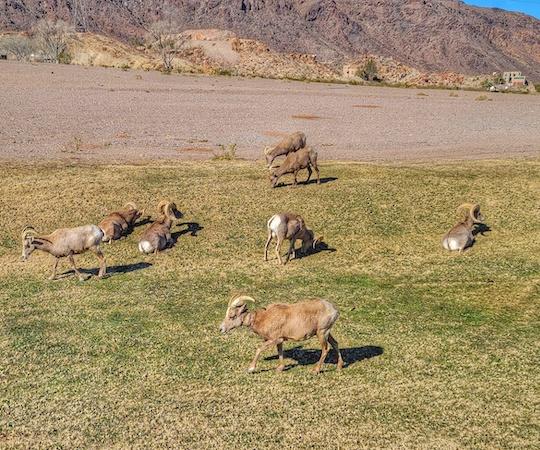
Aside from my labradoodle wearing fake antlers, the desert bighorn sheep is as close as Las Vegas is gonna get to reindeer. Here are a few facts about Nevada’s state mammal, Ovis canadensis nelsoni.
🐏 Evolution has equipped these herbivores to survive in arid deserts: Their light coloring reflects 40% of the sun’s rays; their complex stomachs maximize the nutrition in tough desert plants.
🐏 When it’s cool out, a bighorn can go for months getting their necessary electrolytes from their diet instead of by drinking water. During summer, they can go for up to three days in 100 degrees between drinks.
🐏 Scientists speculate that desert bighorn can lose up to 30% of their fluid weight and still function; for many species 10% is enough to trigger dehydration.
🐏 About the head-butting: As with many males, boy sheep try to impress girl sheep through head-butting contests. They’ve been observed to last more than 24 hours, with as many as five clashes per hour. Swipe right on your fave, ewes!
🐏 Mature males have horns that curl fully — so much so that they sometimes break them off against rocks to improve their field of vision. Ewes have a half-curl.
🐏 A full set of ram horns can weigh up to 30 pounds.
🐏 Conservation status: Least concern. In 2022, Nevada issued nearly 300 desert bighorn sheep ram tags.
🐏 One long-term threat is climate change — not only because it’ll dry up water sources, but because it will impact the nutritional value of the grasses, shrubs, cacti, and acacia they survive on.
🐏 You can see them up close, but don’t get too close, in Boulder City’s Hemenway Park. You can also watch them on the ram cam!