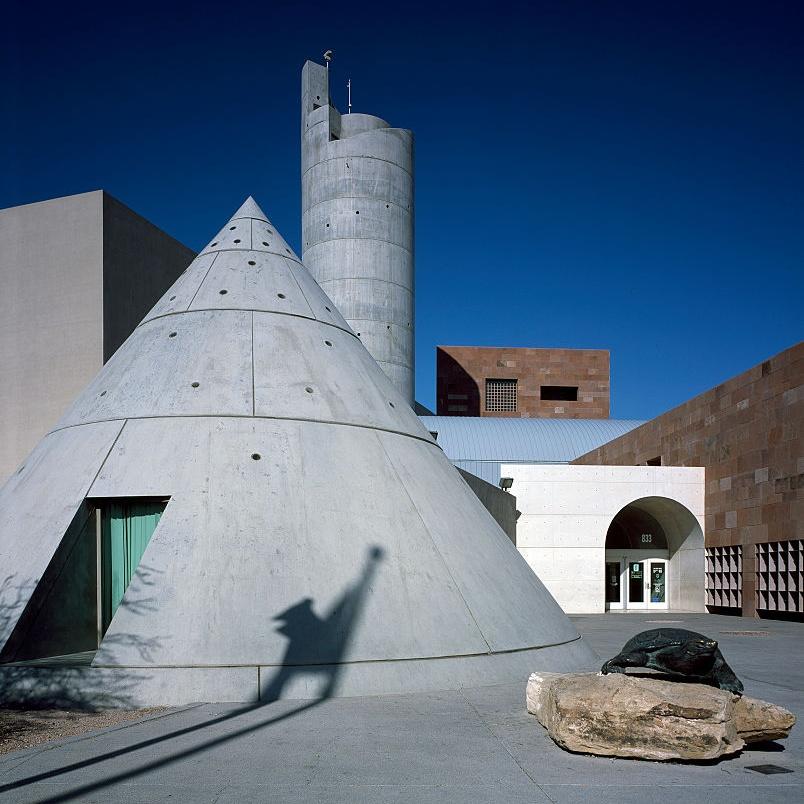
Next week will mark the 33rd year the beauty above has been in our midst. It’s a shadow of its former self, of course; in the beginning it housed the Las Vegas Library and the Discovery Children’s Museum, but both have moved on — I’m told it’s now used by municipal departments. But in its heyday, it was significant in a number of ways, and, in my eyes, at least, it retains its architectural kick.
One of the first local community buildings designed by a “starchitect” — Antoine Predock, a titan of desert modernism — it was also the opening move in the library district’s ambitious plan to create a system of buildings that were more than just big boxes filled with books. The architecture would be equally ambitious, meant to generate neighborhood identity and perhaps even pride. (Hey, distinctive buildings aren't just for the Strip!)
This first job was a coveted assignment for designers. In an interview with UNLV’s Oral History Project, the man behind the library’s vision, former director Charles Hunsberger, recalled a parade of well-known architects coming to Nevada to take the state’s architectural licensing test — they couldn’t submit proposals without passing it.
Predock could no doubt cite complex design reasoning to explain the building’s distinctive visual shape-jumble. (Indeed, on his website, he does.) But in the interview, Hunsberger recalls telling him to imagine the contents of a child’s toy box — which, clearly, Predock did. (Interesting aside: The structure was originally meant to include the state’s shortest railroad track, from one side of the building to the other. Didn’t work out.)
The result, even in dowdy middle age and bereft of its original purpose, remains one of the most imaginative and playful parts of an already playful cityscape.
- More architecture: Build up your knowledge of Paul Revere Williams, the iconic Black architect who did important work here. [City Cast Las Vegas 🎧]