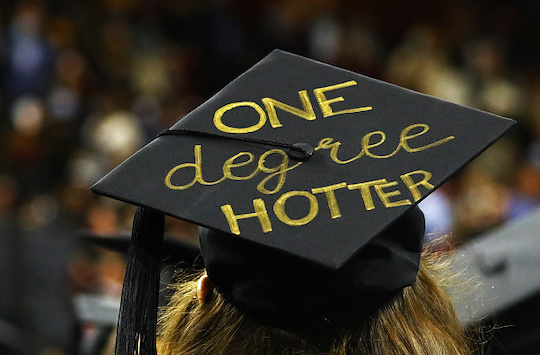
If you’ve ever sat through a college graduation (UNLV’s winter commencement is Dec. 20), you know that one of the few reliable distractions is people-watching, particularly those students who’ve creatively tricked out their graduation caps (the official term is mortarboards). Some write basic slogans, declare community affiliations, or say hi to Mom; others try to be funny; still others add elaborate, sometimes sculptural elements.
Now, if you’re a folklorist, like UNLV professor Dr. Sheila Bock, you begin to wonder if there’s a deeper meaning to what might seem like a throwaway gesture. There must be: She has a book forthcoming from University Press of Colorado, Claiming Space: Performing the Personal through Decorated Mortarboards.
Consider a university commencement: vast, ritualized, the robes subsuming everyone’s individuality into the message of the institution. Decorating your cap, a tradition that emerged in the 1960s, becomes a way of, per Bock’s title, reclaiming a bit of your own space within that impersonal ceremony. Says Bock, “One person I interviewed said, ‘It’s your way to get the last word in your educational journey.’”
It’s often more than that, though. “It’s very much shaped by larger notions of self, and education, and community, and the unknown future,” Bock says. For example, white graduates she interviewed overwhelmingly considered their cap decorations to be amplifying the goals of the graduation — to celebrate their achievements. Whereas, for people with more marginalized identities, displaying their true selves so visibly in that space is often a way to push back against an institution they haven’t always felt comfortable in.
Still others use their mortarboards to acknowledge anxieties about post-collegiate life: crushing student debt, the job market, the state of the world. They’re often proposing a contrary — yet grittily real — narrative at odds with the idealized message that the graduation itself presents. In this way, students are joining the urgent, ongoing discourse about the value and meaning of higher education.
And, Bock notes, the caps serve another function: They give the rest of us something to look at during all the speechifying and rote applause. “That should not be discounted either.”
- Dr. Bock will discuss her research in a free public talk tomorrow at 3 p.m. in UNLV’s Literature and Law building.