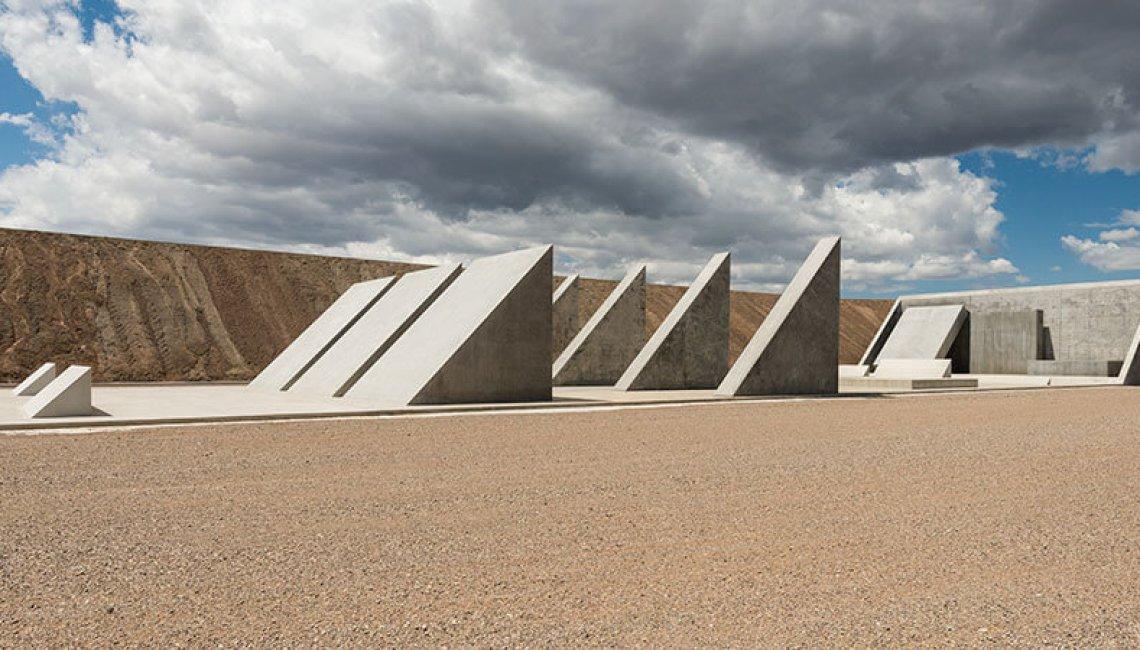
The largest contemporary art piece in the world is also among the most remote. “City” took more than 50 years and $40 million to build, supported by private donations (from the likes of Elaine Wynn) and commissions by art museums and other institutions.
🤔 What Is It?
“City” is the grand masterpiece by Michael Heizer, a reclusive artist who lives on a ranch next to the art installation with his wife. The geometric collection of dirt, rocks, and concrete stretches about a half-mile wide and a mile-and-a-half long (or for perspective, about a quarter of the length of the Las Vegas Strip). It’s about four hours north of Las Vegas in Garden Valley — a plot of private land inside the Basin and Range National Monument.
🚌 How Do You See It?
“City” is maintained and managed by the nonprofit Triple Aught Foundation, which offers tours on an extremely limited basis, usually three days a week between May 1 and November 1. (This year’s schedule is fully booked, but you can put your name down on a waitlist in case any cancelations pop up.) Tours are limited to just six people, who each pay $150. A truck picks up visitors in the small town of Alamo and drives them out another 60 miles north to spend about four hours at “City”. No cellphone service. No photos allowed.
Admission drops to $100 for students and is free to residents of Lincoln, Nye, and White Pine counties, although reservations are still required. Bookings for next year open on January 2, 2026 at 9:01 a.m.
☀️ What Being There Is Like
Those who’ve visited “City” describe being immersed in the immensity of the piece and think about it for days after leaving. The artwork is “about the experience of time — both the long hours necessary to explore it … and in the texture of being there, isolated from any sense of what time period you’re in,” according to former Hey Las Vegas editor Scott Dickensheets, who visited in 2023.
There are no set instructions. Guests are free to roam at their own pace among the structures, dirt mounds, and depressions that carve road-like pathways throughout the property. “City” is so vast, it’s meant to be an in-person experience explored from within — not viewed from afar. (Even the Google Maps satellite view appears to be blocked out.) The ends include monumental structures reminiscent of ancient ruins — and could be mistaken for some when discovered thousands of years from now by future archaeologists.
🏜️ Future and Legacy
“City” has drawn criticism from those who say the piece isn’t truly part of the Land Art movement, since it’s not designed to decompose back into its natural environment. Some complain that “City” intrudes on sacred tribal lands and the Triple Aught Foundation acknowledges the work was created within the ancestral territories of the Southern Paiute and Western Shoshone.
Regardless, funds and plans are in place for “City” to continue indefinitely. Whether the installation is complete or continues to be a work in progress isn’t clear, perhaps even to Michael Heizer himself. When the region became the Basin and Range National Monument, the artist reached an agreement with the Bureau of Land Management to open “City” to the public, which happened for the first time in 2022.
- Learn more about Basin and Range, as well as other national monuments in Nevada. [Hey Las Vegas ✍️]