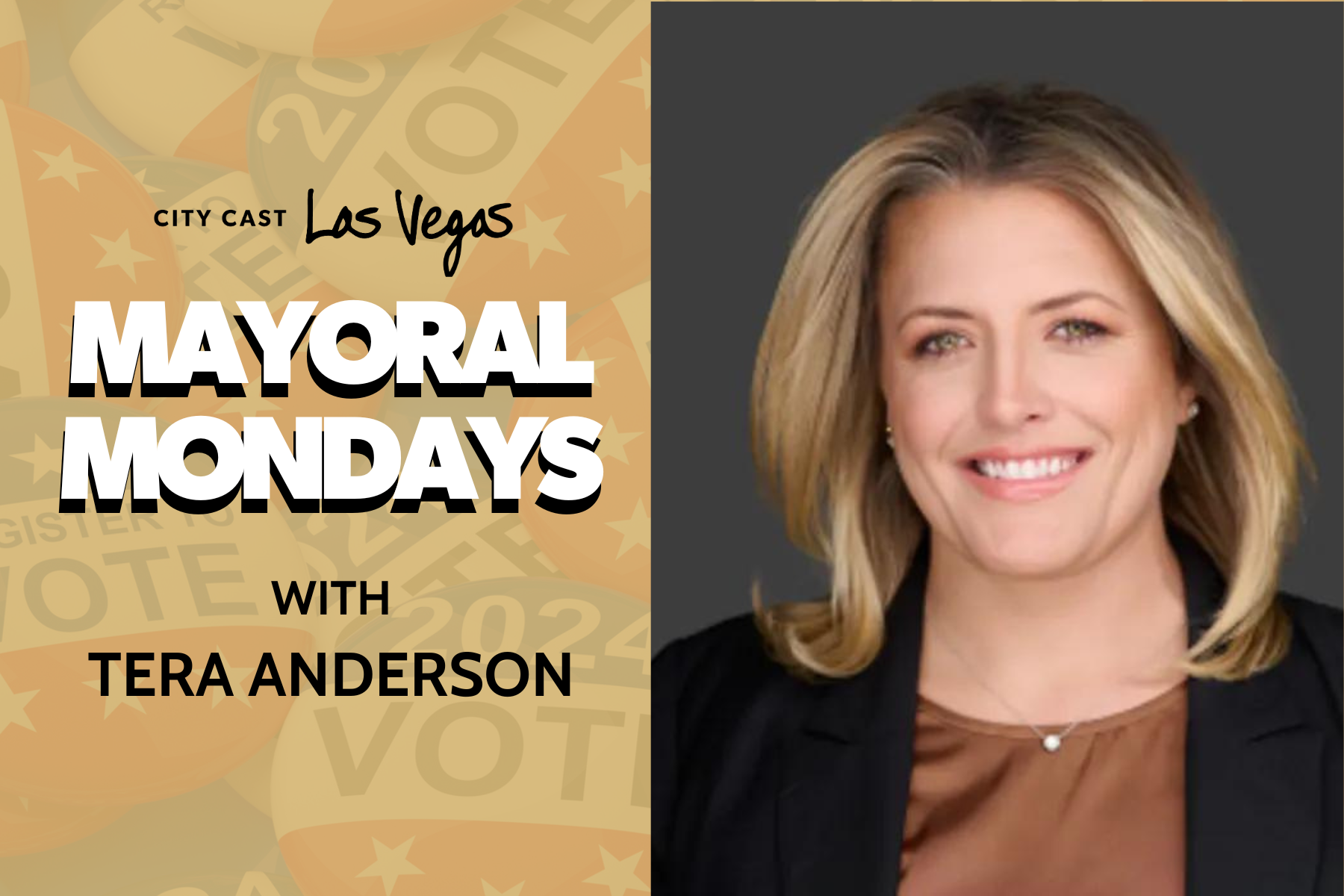
Our special series on the Las Vegas mayoral race continues: Today, co-host Dayvid Figler interviews mayoral candidate Tera Anderson, a second-generation Las Vegan. They talk about how her experience as a businesswoman working in land and economic development influences how she’d tackle affordable housing, the Badlands brouhaha, and growth in our urban center.
Find more of our coverage on the Las Vegas mayoral race here.
We’re on social media! Follow us @CityCastVegas on Instagram. You can also call or text us at 702-514-0719.
Want some more Las Vegas news? Then make sure to sign up for our morning newsletter here.
Learn more about your ad choices. Visit megaphone.fm/adchoices.
Want to follow along while you listen? Here's the episode transcript.
Disclaimer: This transcript was auto-generated. Please excuse any typos or confusion.
Dayvid: Our mayoral profiles continue today with candidate Tara Anderson. Tara is a longtime Las Vegas and touts her civic engagement, as well as her experience as a businesswoman working on land and economic development. Today on CityCastLasVegas, we chat with Tara about her campaign and positions as she vies with 13 others for the role of Mayor of Las Vegas.
It's Saturday, May 4th. I'm David Figler, and here's what Las Vegas is talking about. Tara Anderson, welcome to City Cast Las Vegas.
Tera: Thank you very much for having me. Happy to be here.
Dayvid: Well, tell us who you are and why you're running for mayor. Standard questions, Tara.
Tera: Happy to answer. I am a second generation native of Las Vegas and while I did not have a long standing desire to get into politics or, or run for office, mayor was not on my bucket list, I do live my life based on the principle of find a need and fill it. And given where we are in our evolution as a city, And some of both, I think, the untapped potential and even some of the challenges that we're facing as a city.
I believe that I have timely and relevant skills. I've been in land and economic development for the better part of 20 years. And part of my career included, I was recruited by both the City of North Las Vegas and the City of Las Vegas to help with Infrastructure planning, real estate matters, growth planning, um, and just how we deliberately evolve as a city in ways that are value add.
And so, I have been, I describe that period of my career as Affectionately, is the belly of the beast, and I do understand municipal governance and how it works, and I think that's a vital part of this role.
Dayvid: Great. Tara, are there any projects or accomplishments, uh, that you were able to achieve that you want to highlight during, um, working with the, the city of Las Vegas?
Tera: I was heavily involved with, um, some of the residential projects that are now, um, gaining traction and under construction in Symphony Park. I was, uh, part of negotiations on some of our medical district initiatives, which now is leading to forthcoming groundbreaking on, uh, Um, residential, parking, and I believe now it's evolved to include a hotel component.
these are long term project concepts, especially when you have public and private partnerships and partners that include UNLV or um, you know, county hospital assets, etc. And so they, they take a long time, but I'm very, very proud of that work. And, and most importantly, I, I incredibly value. The knowledge and understanding really the mechanics of, of how the city works, because if you want to be the architect of a solution, you have to also understand, you know, the, the construct of the system and
Dayvid: Sure,
Tera: be working within.
Dayvid: And what, what was your role in, in those projects?
Tera: So I served as the redevelopment agency manager for the city of Las Vegas. My primary. Focus on negotiating complex real estate matters, um, scrutinizing applications for city subsidies for economic development activity. Um, and a lot of land use right of way issues, just so that we, as a city, as we evolve, we're.
Making sure that new business or development opportunities are highest and best use for what we need to see, um, you know, new housing projects or commercial projects or even new businesses that we want to fill vital gaps in our market. And so I was kind of on the front end of, of those discussions.
Dayvid: Tara, generally speaking, uh, people who run for mayor, tend to have at least some beef with the city, uh, that they're running in. I'm wondering, is there something that the city government is doing now that just burns you in a way that you'd want to change as mayor?
Tera: There's, there's probably really three areas that I don't know if burn would be the word, but yes, I think, um, it's natural to identify things that you think are, are untapped. potential or, or potentially problems facing the city. And one is the city of Las Vegas, and I can't stand fear mongering in politics, so I say this as objectively as possible.
The city of Las Vegas is staring down the barrel of financial insolvency, um, bankruptcy, because of how the city has engaged in an eight year long protracted, um, fight over the Badlands golf course. And the city is not winning, and it's not over. There is, this is still an active engagement. The city has had eight years to extract the taxpayers from this fight, but right now there's about 250 million worth of judgments that have been imposed upon the city, and there's still an additional hundred acres of land to be fought over.
So this is an ever growing problem, and not just in its own right, but if the city ends up spending that kind of money on avoidable litigation, it displaces our ability to make value add investments and, and tackle other really important socioeconomic issues. And so there's an opportunity cost that's even more dire as a result of this fight.
So that's, that's a number one issue for me. The other is having been somebody who's operated and worked in land and economic development, I think the city has a lot to be desired on being competitive in that if you want to build something, start a business, be an active, engaged citizen, the city needs to increase its predictability.
And what I mean by that is if you want to, when you engage the city, you should be able to know What is it going to cost you? What's your time to market? What kind of licensure is required? What is the fee schedule, et cetera, so that you can make business decisions and that we as a city can compete with our peer cities in the region, North Las Vegas, Henderson, Salt Lake City, Phoenix are outperforming us because their processes are more navigable.
And so being that this is an area that I navigate in my career every day, I believe it's a wealth of experience and knowledge. that I can apply to help, um, increase that predictability for our business community and our constituents. The other, the other piece of it is, thirdly, I guess, is,
Dayvid: Well, you did say three issues, so I was going to hold you to
Tera: uh, three.
Yeah, you're going to call me on that. Good. Hold me accountable, David. So the third is transparency. I do think when painting with broad strokes about politics, there is a growing loss of confidence in government in that, is it really working for us? Is there the transparency? So that we know that there's merit based decision making and that it's not just, um, about political influence or political expedience, but that we really, as, as city leaders are making decisions that can quantifiably.
Um, be value add to our residents, our business community, our visitors. And so I want to be the most accessible, navigable city in the country. And the old adage of, I know a guy, needs to die a very rapid death in my view. It needs to be something that whether you're a day laborer or you're a, A wealthy business owner, you should have the same, uh, degree of access and visibility to what your government's doing and why it's doing what it's doing.
Dayvid: Now you mentioned Badlands and unsurprisingly it's come up with a lot of the candidates. Um, it, it looks like there's going to be a monster judgment to deal with. So what would you suggest we do? I mean, looking back in hindsight is one thing, but looking forward with this huge debt. What do you bring to kind of the resolution or the.
The impact of this judgment against the city that the other candidates don't.
Tera: So, first and foremost, we have to extract the city from the ongoing litigation. And that begins with approving the land entitlements that were, uh, allowable based on, you know, land use rules from the onset. And that takes the, the loaded gun out of the developer's hand to continue to, to, um, win these litigations against the city.
And so that has to happen immediately. And then I, I do believe that the developer, while I haven't had direct conversations with him about this, but developers tend to be inspired by developing. I don't believe that his intention was to get a pound of flesh out of the city, but he does, he has incurred real costs by being engaged in this litigation, but subsequent to approving the entitlement, the city's going to have to negotiate on, um, how, how, what exactly that pound of flesh is in dollar values that the city's going to have to pay for, Um, this fight that they've been engaged in.
Dayvid: Now you're right, I did uh, ask you about like, what beef you might have with the city or things that you don't think they're doing great. Um, but let me flip that question around a little bit. What do you think that the city of Las Vegas is doing right, right now?
Tera: So I think that this city, one, I have a tremendous amount of respect for Mayor Goodman because in a time where there's been an ever growing dynamic of incivility in politics, she has been somebody who has been steadfast about maintaining decorum and having reverence for the office and how you conduct yourself as an elected official and I, I think she deserves a lot of credit for that.
The city has been, um. I think it's been right in focusing on downtown revitalization. and it's the next appropriate evolution for us as a truly urban environment. There's also a lot of great opportunity that comes with, um, that increased density in, in offering more innovative transportation solutions, in, um, increasing walkability, increasing, um, other ermine elements that we just haven't had as a city.
We've always been sort of accustomed to suburban sprawl and, and while that's important. Um, it's, it's also important that we have diversity in our options, in our commercial and our residential options. And I think that the city has, has been very creative in trying to, um, support and foster the core of our city and, and some of our most historic areas.
Dayvid: Tara, uh, you mentioned, uh, projects like Symphony Park, uh, you know, the revitalization of downtown. It doesn't come without criticism that there, uh, has been maybe gentrification around that area, um, that the, uh, level of development has not been mindful of the impact on people who are unhoused, and we see more unhoused people around the area.
How do you respond to those concerns?
Tera: I think they're very real concerns and they're appropriate ones. And the way you solve for it is by electing people who understand land development and how you, um, successfully achieve the economics needed for viable other, uh, projects. For example, the City has offered, has sold City owned land for residential rental properties.
It needs to prioritize. Um, and, and emphasize the need of increasing homeownership. And so, I will support any city subsidies, if it's going to go for residential project development. It needs to prioritize owner occupancy. Because homeownership has proven to be one of the most stabilizing economic forces in history.
And in our valley right now, we have homeownership at an all time low. And we're seeing the displacement of our workforce that is the backbone of this community. median home prices exceed median income by like 42%. That's not acceptable. And so we have to be very intentional and deliberate about the kinds of residential projects that we build to make room for the people that are the backbone of our community so that we don't have housing instability.
Um,
Dayvid: Now, workforce, housing, which I think is what you're referring to there, it's just people who are in the workforce who are just struggling to afford places, uh, has been kind of universally a push from the city, uh, but not necessarily building, Residences for the unhoused. Would you support, uh, either private public partnerships or some other means to get more housing, built so that people who are outside would actually have four walls, maybe supportive services, et cetera, moving forward?
Right.
Tera: I, I would, but I think we're talking about two, I want to make a distinction. There's, there's accessible housing for people that are employed that are currently priced out of the market, right? Because median income doesn't align with median home prices. That group we absolutely need to, to achieve and build projects that are, uh, financially in alignment so that they are not competing with investors, they're not competing with, um, institutional investors notably.
But that it's, it's prioritizing access for owner occupant long term residents who are, again, the backbone of our community. The unhoused population I, I would support temporary housing solutions. I'm a big fan of, of being compassionate about the struggles that anybody in life faces, and I think everybody's deserving of, of a hand up and a helping hand when they're in need.
Um, and that's where temporary housing should be available to make sure that people are safely housed, that they're not on the streets. Um, it keeps our streets clean, it keeps our, our business communities thriving, and it keeps the unhoused. Um, protected. But those need to be temporary solutions that are supported by other programs that help them, um, create the economic stability and the, the self sufficiency and, and independence and frankly the human dignity to be active parts of our community.
And so, um, I would support temporary housing. Yes, I would.
Dayvid: Tara, last question. Um, you know, there's a lot of different parts of this community, uh, but if you could pick one person, I mean, as the mayor, uh, you would pretty much be able to summon anyone you want for a very long lunch. Um, who is the first person you would ring up to have a long talk to figure out the pulse of the city, and that person can't be named Goodman or Figgler?
Tera: Just somebody to talk to about the goings on of the city.
Dayvid: To get that flavor or that pulse of what's happening in as much of the city as maybe you don't know about or that you want to hear from.
Tera: That is a really great question and to identify one person that would be all encompassing because you do have
to,
Dayvid: Well, who's the first person? So you're going to be able to have a sequence of people, but who's the first call that you make because they're going to say yes.
Tera: gosh,
Dayvid: let me put the pressure on you. Everyone says this is a hard question, but everyone has come up with someone.
Tera: is a really hard question and for me it would be very issue specific. Um, really because I'm, I'm very passionate about solving the housing problem. Really, probably the first person I would call would be Mike Mullen.
Dayvid: Okay. And Mike Mullen, uh, I know who he is, but maybe describe who he is for, uh, the listeners
Tera: He has been in the community for years and years and years and years and a very successful, um, real estate developer in his own right, who also has been a leader when, in achieving affordable housing in Southern Nevada and was really the first. to pioneer, um, putting together collaborative project concepts between public and private partnerships and also building, um, affordable housing projects in Southern Nevada.
And so he's a wealth of information, not just on the development side, but navigating, um, some of those multi jurisdictional relationships that, um, are so important if you're going to be successful in collaborating with folks to, to. You know, accomplish great things for the city.
Dayvid: Uh, yeah, for many years, Mike Mullen was involved with a non profit organization called
Tera: I'm sorry, yes, I should have probably just named his Yes, he was the founder of Nevada Hand, actually.
Dayvid: Right. Well, Tara Anderson,
thanks so much for joining us here on CityCastLasVegas.
Tera: Thank you very much for having me. It was a pleasure. I
Dayvid: That's all for today here on CityCastLasVegas. If you enjoyed the show and our coverage of the mayoral race for Las Vegas, hey, go tell a friend! Rate our show, leave us a review, and subscribe to our morning newsletter.
We'll be back soon with more news from around the city. Till then, stay lucky.