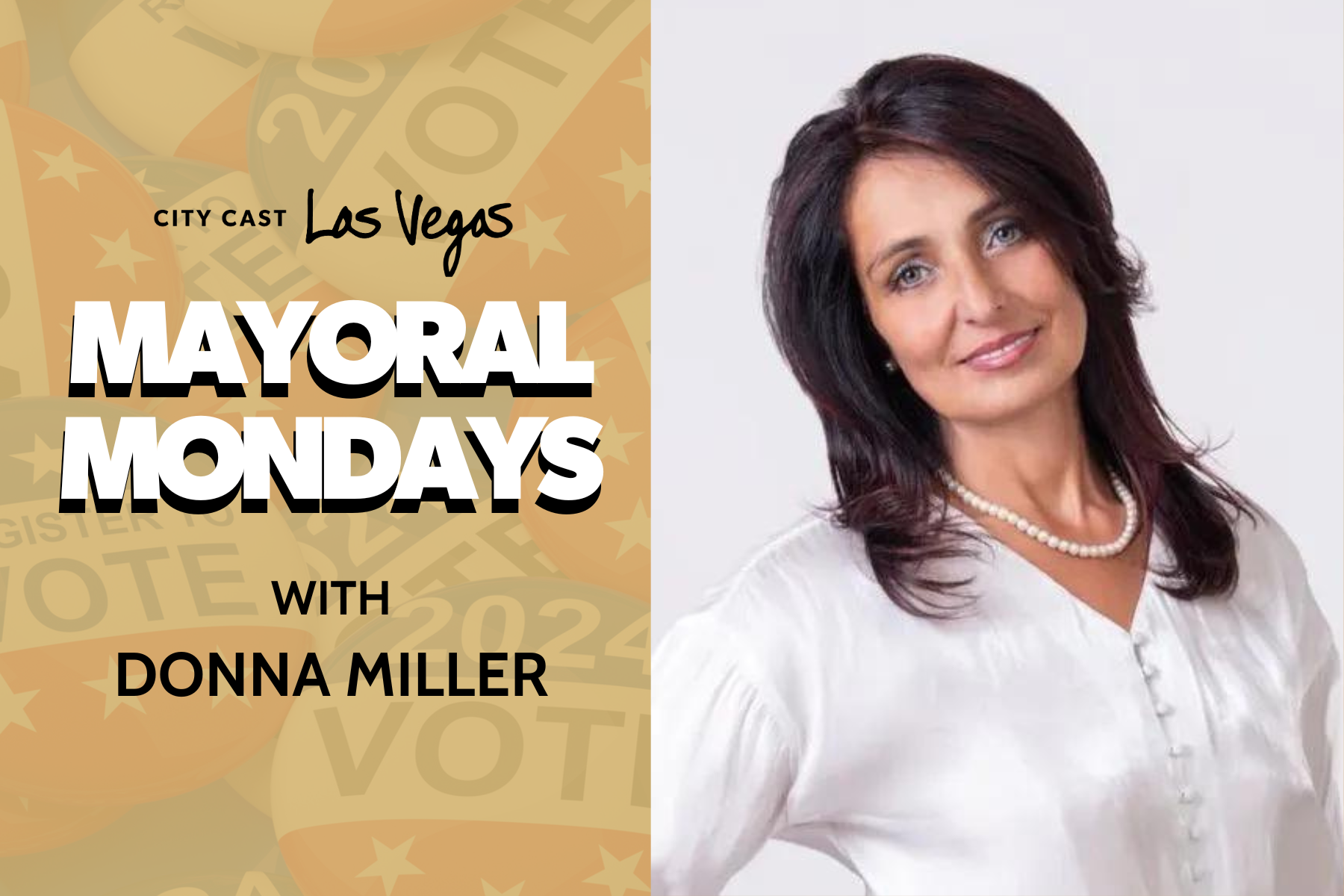
For our final candidate interview in our series on the Las Vegas mayoral race, co-host Sarah Lohman sits down with Donna Miller. Donna is a veteran nurse, former regional director for the AMR/MedicWest ambulance companies, and medical entrepreneur. She talks about why her vision for public safety encompasses emergency medical care, the economic potential of the medical district, and how her life experience has influenced her ideas for addressing homelessness in Las Vegas.
We’re on social media! Follow us @CityCastVegas on Instagram. You can also call or text us at 702-514-0719.
Want some more Las Vegas news? Then make sure to sign up for our morning newsletter here.
Learn more about your ad choices. Visit megaphone.fm/adchoices.
Want to follow along while you listen? Here's the episode transcript.
Disclaimer: This transcript was auto-generated. Please excuse any typos or confusion.
Sarah: If you're following our coverage of the Las Vegas mayoral race, you might already know it's a crowded field. Out of 14 candidates, nine got back to us to schedule interviews. So today on CityCastLasVegas, we're talking to the final candidate in our series, Donna Miller.
Donna is a long time nurse who also served as the Regional Director for the AMR Medic West Ambulance Companies and founded her own emergency medevac company that retrofits airplanes. She's running on a platform of affordable housing, public safety, and the untapped economic potential of the medical district.
It's Sunday, May 19th. I'm Sarah Lohman, and here's what Las Vegas is talking about.
Donna, tell us who you are and why you're running for mayor.
Donna: Well, thank you for the question and thank you for the inclusion on this podcast. I, um,
I feel very Privileged and honored to speak with you, um, regarding my new journey of running for the mayor. Um, I am not a career politician. I am a nurse that has been in this community for more than 25 years, um, and, and, and served in different roles.
As you mentioned, as a nurse and first responder for about 20 years, as a business owner for about 25 years, successful business owner that started, uh, Business from scratch and, um, uh, grow it into a multi million dollar, um, entity and service to our community. And as a community leader who's been involved, uh, with the government, um, at the local level, at the state level and at the national federal level.
I feel like every experience that I had, um, has prepared me for this very journey. Um, as I believe that it's time for our community to be led by a person who, um, can put our community first and as a nurse for 28 years, putting others first is, um, second nature to me. I also believe that Um, it is time for our city to be run by a business person who understands the value of the dollar and the challenges of small and large businesses and the values of those two working together.
Sarah: what brought you out to Vegas?
Donna: So I am a first generation immigrant, I like to say, but my daughter likes to correct me and she's very right. She says, you're a first generation American. So, so I, I am originally from Romania. I was 21 years old when I came to the United States. Um, I don't speak any English. As a matter of fact, I learned to speak English while watching Mr.
Rogers Neighborhood with my daughter. Um, I, um, my, my entire life, I came across people, my entire adult life here in the United States, I came across people that believed in my story, um, and, and gave me a hand to assist me in making my dream reality. So when I went to nursing school, I didn't speak English.
So I had the nursing book on one hand. And the dictionary, and the other.
I became a flight nurse in 2002, and before I knew it, I decided that, um, I can, um, build an air ambulance that could service this community better than the options we had at the time, which were not, uh, local options. So that's how lifeguard flying ICU, uh, got birth in 2002.
Sarah: let's talk a little bit more about some of your work. Tell us about one accomplishment in particular that you're, that you're proud of.
Donna: so as, um, um, an air ambulance. Um, as a nurse and operator, I learned a lot about the challenges that we've had. Um, one of the accomplishments that I'm very proud of is changing legislation that has to do with EMS, um, access with, I'm sorry, with access to health care. Um, when, when I, Learn about that challenge.
It had to do with a patient that had an outcome that was undesirable and I was trying to figure out why and learned that there was a loop in the, um, in our law that allowed for companies from out of state that did not have, um, legislation, uh, at Their home base in their hometown. Um, and they were exempt from hours.
So in 2013, actually, I pursued that legislative change and, um, I the law passed unanimously. Then in 2013, we went back in 2015. We went back and build up on that legislation. And for the second time, our BDR turn into law. Um, passed unanimously and turned into law. So that would be one of, uh, my, um, the things that I would, I'm very proud of.
It took an entire community to make that happen, right? It's not me, Donna Miller, making it happen. It was me not giving up until I found a solution, and it was working with other air ambulance, um, providers statewide. And with the local health district and the state health district in order to, and, and of course the legislators in order to make that, um, come true.
Sarah: So what do you think should be the top priority for a new mayor, whether that is you or someone else?
Donna: So I think, um, mindset would, would be, one of my top priorities. And I'm saying that because, um, I believe that, um, Um, we are in, we live in very, um, volatile and disruptive times and things that, uh, were working for us in the past solutions that were working for us in the past are no longer working today.
So we need to, um, stop for a second and reassess. Uh, what are we, what are the, the challenges that we are encountering today? Um, look at the solutions that we've applied so far, um, keep the ones that, that are still working and give ourselves permission to let go of the solutions that are not working anymore.
Part of that is working with, um, each other. Collaboration, whether it is internal within the City of Las Vegas or with other jurisdictions, um, or between government and, um, Private entities. Those collaborations are very important. Co creating solutions. Win win solutions that is. Meaning that if we work together on finding out the right solutions that would be sustainable and solutions that actually would be, um, Not only to resolve today at the expense of tomorrow, but would be resolving today and building tomorrow.
Sarah: you said we're living in a very volatile and destructive time. What does that mean to you?
Donna: so disruptive, um, things are, are, uh, Yeah. Um, so, so it's volatile. Things are changing very fast.
So let's take EMS, right? EMS, is, is, um, in crisis. It's a system that is broken and it's broken nationwide, right? It's not just broken in the city of Las Vegas. It's broken nationwide. Most people, for example, don't know that EMS, um, is only reimbursed when, when they transport patients.
So the EMS, that is the Emergency Medical Services. Um, in other words, the Ambulances, ground ambulances, for example. So a ground ambulance does not get to be reimbursed or paid unless they transport a patient. There is no reimbursement for readiness, for example. So what that translates into is the fact that the reimbursement model is irrelevant for today's reality.
The funding is unpredictable, the, the Funding is inadequate, um, and what, what that's causing is low pay for the workforce, creating the critical workforce shortage. I'm sure we've all heard the challenges that we have with the healthcare workforce, and that includes the EMTs. Um, all of that translates into longer responses for our, um, medical, to our medical emergencies, so it directly affects our population.
So, What worked, that system may have worked in the past, obviously it had for so many years, but is it working today? Is that, um, um, is, I believe that reinventing our EMS system has to be a high priority. And we have to do that before too late. And by too late, I'm saying, and I don't want to scare anybody, but we don't want to wait for us to call 911 and to have no one responding to our emergencies immediately.
So, um, Education is a big part of my, um, campaign. So, um, because of what I just told you about EMS being in crisis, I actually am doing, uh, an event during the EMS week, which is next week, uh, that is, um, um, an awareness event. And it's an invitation, uh, to key, um, community leaders to participate in a conversation and hopefully start a.
further dialogue and brainstorming regarding EMS.
Sarah: So, as a medical professional, you've called Las Vegas medical district a gold mine. What did you mean by that, and what are your plans for this area?
Donna: So the medical district, um, is, is a great opportunity to explore, um, in order to, um, improve the access to care that we, uh, need for the, the, our community. So being in an air ambulance industry, I know firsthand the type of patients that we need to transport because we don't have access to those services here.
For example, transplants. Every single person that needs a heart transplant, a liver transplant, basically anything outside of the kidney transplant has to be transported somewhere else. Having a transplant service here locally is very important and the medical district is a perfect venue to make that happen.
And be creative about how we make that happen. Um, when, when you're saying that a patient is going for a transplant somewhere else, it's not as simple as this patient is just going to go and have surgery there. It has a lot of planning. It implies a lot of planning before the transplant and after the transplant, those patients actually have to move.
Some of them have to move to the transplanting facility because once their organ becomes available, they have three hours Let's say, depending on the organ, it could be three to five hours to, uh, from the moment they identify that the, uh, the organ, uh, is compatible and it's available to them until the moment they have to be on a OR table.
So, because that's almost impossible from here, let's say, even if you're transplanting facility, it's in Southern Nevada, it's in Southern California, people that are high up on the transplant list, they actually move to, uh, To California, we're closer to the transplanting facility in order to be ready and be in a position to, uh, timely arrive to the OR.
That causes disruption, uh, to the patient, to the family member, because you have to have your caregiver in order to start the surgery. It causes financial, uh, disruption. Disruptions. And this is just prior. After, they have to do follow up care for every single one of those. They actually have to go back to that facility, um, in California.
So see how just one item would make such a huge impact on our community if we were to develop that capability here in our medical district.
MUSIC
Sarah: So let's move away from medical for a bit. I know that's where a lot of your background is. So I want to hear about some of your other ideas for the city. You're also running on a platform of increased public safety. What would that entail?
Donna: So, um, the EMS is part of the public safety, so that is definitely, um, a part of, uh, looking into, uh, the solutions on how to resolve, um, the EMS, um, but public safety is a pression, a pressing challenge, um, nationwide and particularly in our valley because I believe our public safety framework is no longer, um, adequately serving.
So to me, it's very important to really find that public, what public safety means for our community today. And, um, uh, I believe that it needs to encompass a broader, uh, more holistic approach and perspective. Um, that includes consideration for public health and, um, overall wellbeing. So for example, um, Today we rely heavily on the enforcement on the law enforcement alone, um, to provide public safety when in reality, I believe that, um, community engagement would be very important, um, and not only, um, in the prevention, but, um, also in, um, addressing certain issues.
So that shared responsibility, um, it's very important, uh, to me. In order to increase the safety for our, um, entire, um, valley. Um,
Sarah: by community engagement? What would that look like?
Donna: so, so engaging our citizens in, um, meaningful dialogue to identify what our issues are, what are our priorities, um, reimagining our public safety together. Uh, once again, I believe in co creation, um, and, and I think that when we do that, we, Take ownership rather than just following somebody else's, uh, direction.
Then cultivating that trust and transparency, uh, that we lack today. Um, we, we talk about defending the police. Um, I don't believe in that. I think that we need to, um, really look at the issues and, and look at the pros and cons, figure it out once again, uh, what works, keep that and, and develop new, um, Develop new strategies in order to increase that safety and that includes more than just the law enforcement.
It includes all of our community.
Sarah: Can you give us some examples of concrete public safety policies you'd push for as mayor?
Donna: So I would probably like to see the integration of technology in the public safety. I know that we have CES here in town every year and I walk away from CES very excited about a lot of the technologies that are being presented. But I can't tell you really and I may be wrong, but I can't tell you really.
What do we, um, walk away? Do we take one item away from the CES to implement in our community? Um, the utilization of drones, for example, would be, um, Uh, something that I would be very interested and nothing is perfect, right? So we would have to look once again at the pros and cons and balance out the benefits of the community and, uh, create regulations that are not infringing, for example, on the, um, uh, Privacy of our citizens.
Um, um, also I've seen this past CES, I've seen Robocops, uh, where I think that there's something to be said about that. I know that, that, um, those are implemented and, um, different, uh, communities outside of our, uh, City of Las Vegas. And I'm not sure about the United States, but I know they're being implemented somewhere else.
So definitely technology would be, um, have a high priority. And I know we are going to say with what funds, right? Because all of that costs money. The, the, um, I think that the drone, uh, Um, application. Uh, it can be pretty wide and it doesn't have to be that expensive. The RoboCop might be a different story.
Uh, I do believe that looking at the budget and the programs that we currently have and making determinations of whether certain product programs are doing Um, what they intended to do and if they are perhaps, um, um, you know, continue or improve on it. Um, but if they're not, perhaps we need to put a stop and, and reallocate those funds to programs that would better benefit the community.
Sarah: So let me ask, since you did mention there is a cost to this. A recent FBI, excuse me, a recent FBI report on crime stats in 2023 shows that murder, violent crime, and property crime are all down. Uh, so and you can clarify for me, but I believe across the country, both across the country and in the Las Vegas Valley.
So why is public safety such a high priority for you if crime is down?
Donna: So I think that, um, technology also has Um, contributed to the crime. Um, I know, um, one of my neighbors recently said that there was a certain, um, activity, um, in the community that she lived in, um, and, uh, she said that there is, um, a lot of neighbors that actually have video cameras and they have this, uh, activity on video camera.
So, I was able to reach out to our police department and they immediately sent, uh, An officer to look at the cameras. And it's my understanding that the issue has been addressed. So I think that, um, if, um, crime is going down, uh, which honestly, I, it doesn't feel that way when, when you hear about some of the crimes, like, you know, having people robbing iPhones.
Apple stores and midday in Summerland. It just feels like people have the courage that wasn't there before. So if there is something that we could do, utilizing technology to prevent that, that's very important.
Sarah: So, homelessness is up across Southern Nevada, um, it's up 16 percent in between 2023, excuse me, it's up 16 percent between 2022 and 2023 alone. What would your approach be as mayor of Las Vegas to solve this problem of homelessness?
Donna: Well, I'm glad you asked. Thank you very much. You know, homelessness is a challenge to, um, not, not to us. Nationwide, right? But I think that we are, um, very unique and in many ways. Um, there is a few things that I would do. First of all, we have resources that are not easily accessible. So one thing that I would do immediately.
It's almost it's it's creating a, uh, Um, an Expedia type of services where someone can go and say, this is my issue. Um, I need assistance with housing. And then that would simply and directly and easily direct them to the available resources. Um, it may be housing, it may be, um, um, health related, such as mental health.
It, um, uh, could be. Um,
Sarah: like, expirio, you mean they could go on an app and say, you know, here's what I'm looking for, so like the travel booking website?
Donna: yes, so I'm thinking of Expedia as a very efficient way to list the resources that we have. Um, so yes, that's, that's what I meant. It's almost like a virtual assistant, if you wish, where we're a platform that, that would put together all the resources that we have today. Um, and, and, um, while having those resources sign up.
For that particular website, I will take that opportunity to also assess the quality of those services and see what can I do to enhance their, their abilities and improve that. Uh, so basically my first step would be to make the best of what we have and build on top of that. Um, the, the other thing that, um, um, that, uh, the other priority that I would have when it comes to homelessness is change of the mindset.
We quite often think of homelessness as hopeless less. Hopeless. Uh, so homeless, it shouldn't equal hopeless. Uh, the reason I think that's important is because when somebody feels hopeless, they're not going to make any efforts to get out of the situation that they are in. So if we, uh, re empower the people that are in that bad Chapter of their life.
I think that it would give them the opportunity to reach out and once again, go to a place where they can easily access the resources and take advantage of those resources.
Sarah: What's your stance on the camping ban that's currently enacted in the city of Las Vegas?
Donna: So I, um, I, um, I think that we are not providing what we need, what the homeless needs when it comes to housing. Um, I do a camp, uh, I, I, I, I am one of the leaders for a homeless camp, um, uh, health fair. In, um, the, um, in the courtyard and more exactly, uh, we, we do that at the care center and this coming Saturday is, um, uh, our next, um, upcoming health fair.
So I get to talk to people directly that are in that situation. And one of the reasons for that health fair was to learn. From the source. Why? Why are those people in that situation? And you know, what I learned is that you have 50 people that you're talking to. There's 50 reasons. And some of those people just need a helping hand.
They just need somebody to help them find a job, get an I. D. Others may need some help when it comes to substance abuse. And yes, there are people that need more permanent solutions. So I don't believe that what we have created and that courtyard is humane. I mean, it's people sleeping on the floor, and I'm from a different country.
I have been in the worst, um, um, at the worst time of my life, I was homeless as well. And sleeping in the train stations is not something that I planned for, nor something, someplace that I wanted to be in. So bringing back to your initial question, what do I, what would I do about homelessness? Prevention would be a big focus.
Putting Uh, measures in place to, to, to see when somebody is about to go in that direction. And homelessness is a threat. And that will take a comprehensive approach that will take the entire community to pay attention. Uh, and not only to pay attention and observe it, but do something about it. So, putting prevention programs into place would be very important, uh, in, in, in that phase.
Also exit strategies would be very important to me and do that in a rapid, um, and very timely manner. So people don't get, if they fall through the cracks, um, they, they don't get to become chronic homelessness. And I believe we call chronic homelessness, somebody that's been without a home for more than 12 months.
So being able to triage the people that are homeless already and, um, um, assign, you know, The, um, the implementation procedures to address their needs, um, it will be very important to me.
Sarah: So from your perspective, what do you think the city of Las Vegas is doing right, right now?
Donna: Oh, there's a lot of things that we do, right? I mean, we are revitalizing the downtown thing. There's a lot of, um, movement and a lot of, uh, um, resources for business, small business owners. Um, those are, um, things that, that, um, have to be done. Um, been embraced in in our city. We are a global town, so being able to embrace, um, some of the challenges and not only embrace it, but actually turn it into our, um, advantage and benefit, um, has has been, um, Um, a factor that I've seen in some of the activities of the city, but I'm also going to say that sometimes from my observation, we, um, get to talk a lot about issues, uh, we say, and honestly, listening to, uh, my opponents, uh, more closely than ever recently, I hear a lot about with, um, Um, recognition of the issues that we have.
I hear a lot about what we need to do more about this and not just talk about it, uh, and I agree, but what I don't hear, I don't hear the how. I don't hear of how do we address this issue, right? So the fact that I'm saying EMS is in crisis, I don't stop there. I say what are we doing about EMS being in crisis?
What are we doing before Before it becomes too late, who are the right people to engage in that conversation and how do we do it in a way where everybody's, um, uh, word is valuable? Because it is true. It's not about one entity or another. It's not about, um, uh, private versus public. Government. It's about working together.
So, um, if I am to look back at some of the things that I have done, um, as a leader in the community, not by myself, but with the community, um, I can, um, Um, tell you a few other examples, um, that totally entails the entire community working on that. Um, are you familiar with, um, Nellis Air Force Base receiving non medical, non military EMS patients?
9 1 1
Sarah: I was not.
Donna: So during COVID, um, I was in charge of AMR MediQuest and, uh, part of the challenge that we had and continues to be today is in the northeast side of our, uh, valley, you really don't have a lot of access to care. If you look at the acute care facilities or even, Uh, freestanding ERs. So quite often we would bypass a perfectly capable facility which is the military hospital.
So, um, the military hospital, uh, was approached and, uh, we, and when I asked if possible, they said, To consider to take 911 patients that are not military. Um, to my surprise, the answer was yes. So, uh, it took an act of Congress, literally, for them to get trauma accreditation. They had to change the way they're Um, access to base, um, happen, their processes in order to allow for a ground ambulance that does not have the opportunity to do background checks on the, uh, EMS providers, nor on the patient.
So the patient could very well be a, um, you know, um, someone that, um, in normal circumstances would not be a, um, um, given, would not be given access to the base. So, um, they had to change the,
Sarah: interesting, but I want to make sure that we wrap up in a timely manner here. I know that you're busy, and I want to wrap up with a fun question. So as mayor, you can pretty much summon anyone you want to for a long lunch, right? So who is the first person that you would ring up and have a long talk to about the pulse of the city?
No Goodmans, so no former Goodman mayors, and no City Casters. You can't ask me. Mm hmm.
Donna: That's a tough choice because there's a lot of great community leaders in this community. And I would love to have a conversation with, with many of them. Um, I would say that it would depend on, on, um, what Um, the conversation would be if I am to talk about challenging the status quo, um, and reinventing, uh, what we do in the city, I would definitely call on, um, our sheriff.
And that's because he gets to see a lot of things and I know I've followed him closely through his, uh, campaigning. Bringing humanity back to the table is definitely part, uh, a big part of what he does. So, um, talking to him about how to reinvent the city and where, uh, be best to start, um, I think that that would be a fun conversation.
Sarah: Donna Miller, thank you so much for joining us today.
Donna: Well, thank you for the invitation and thank you for the inclusion.
Sarah: Our pleasure. All right, I'm gonna read a quick wrap up, Donna, and then we'll all be on our way, yeah? Okay. That's all for today here on CityCast Las Vegas. We'll be back tomorrow morning with our Mayoral Mondays wrap up. As a team, we're going to analyze all of these interviews and give you some behind the scenes intel as well.
And if you enjoyed our show, why not tell a friend, rate the show, leave us a review, and subscribe to our morning newsletter. Take care. Great.