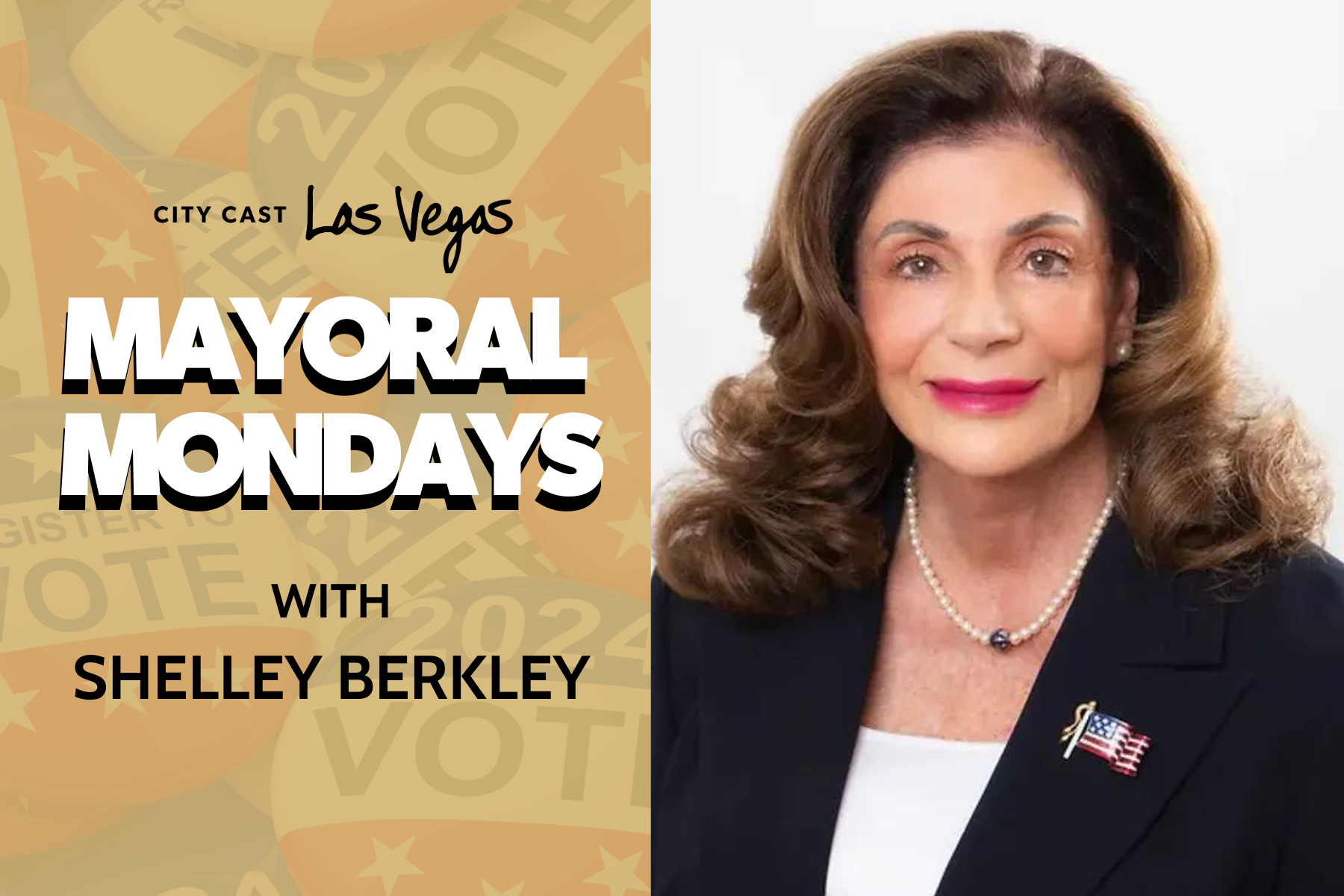
Even though only a third of the valley can vote for the Las Vegas mayor (here’s why), the role has become a bully pulpit on the global stage. So who should be our city’s next spokesperson? In our second installment of Mayoral Mondays, our special series on the 2024 Las Vegas mayoral race, we sit down with candidate Shelley Berkley. Shelley enters the race after serving in the Nevada Assembly, on the Board of Regents, and in the United States Congress as Las Vegas’s representative for seven terms between 1999 and 2013. She and co-host Dayvid Figler sit down to talk about how she'd tackle affordable housing, the Badlands lawsuits, and homelessness in Las Vegas.
Stay tuned for more upcoming candidate interviews: Cedric Crear on May 6 and Victoria Seaman on May 13.
We’re on social media! Follow us @CityCastVegas on Instagram. You can also call or text us at 702-514-0719.
Want some more Las Vegas news? Then make sure to sign up for our morning newsletter here.
Learn more about your ad choices. Visit megaphone.fm/adchoices.
Want to follow along while you listen? Here's the episode transcript.
Disclaimer: This transcript was auto-generated. Please excuse any typos or confusion.
Dayvid: The mayor of Las Vegas is treated as a symbol, an ambassador, and an authority for all of Southern Nevada, even if only a third of the valley can actually vote for them. That's why last week we launched a special series called Mayoral Mondays. Episodes will drop, yep, every Monday through early voting, with bonuses along the way.
Today, we bring the first of three conversations with the top polling hopefuls early in the campaign. Up today on City Cast Las Vegas, mayoral candidate Shelly Berkley. Shelly is an attorney who has lived most of her life in Las Vegas. She served in the Nevada Assembly on the Board of Regents and was Las Vegas representative in Congress for seven terms between 1999 and 2013.
We discuss her return to politics, her views on homelessness and development in the Valley, as well as how things have changed since the old juice days of Las Vegas that she was once in the thick of. Quick note, this episode was recorded on April 15th, days before the latest Badlands Development ruling which went against the city.
It's Monday, April 29th. I'm David Figgler, and here's what Las Vegas is talking about.
so Shelly, let's just start with, uh, this question. You've been away, uh, from politics for over a decade now. Why have you decided to jump into the highest profile elected office in the City of Las Vegas?
Shelley: well, as you know, I, uh, was a public servant for 30 years. I started in the Nevada State Assembly and of course, uh, concluded my service, um, after seven terms in the United States Congress. When I came back from D. C., I became the CEO and Senior Provost of Touro University Medical School, which is the premier and largest medical school in the state of Nevada.
Uh, Touro is educating the next generation. Um, I, after nine and a half years, I decided that it would be a really good idea if I left on a high when everybody loved me at the school.
But then I started thinking, what am I going to do with the rest of my life? I'm very healthy. I've got tons of energy. I've got more knowledge than just about anybody on Earth. that are fundamentally important to a growing state of Nevada, particularly Southern Nevada and the city of Las Vegas.
And what is it that my passion is? Uh, David, you've known me for, uh, probably most of our lives, and the reality is what I love is Um, it's a passion of mine. Um, I'm good at it. And I just decided that, you know, I looked around, I wouldn't be interested in going back to D. C. or Carson City. How could I do public service?
And of course, the logical, um, decision was to run for mayor. So I gave it a great deal of thought. I know what this takes. You know, I, I, I pride myself on being a consummate public servant and I am very accessible. But I also know that it takes a great deal of time and a great deal of effort. And so once I made the decision that I was ready to make this commitment, It all fell into place.
And it just felt right to me. And I rolled up my sleeves and started running for mayor. And I've been doing that now, or this now, for about a year.
Dayvid: Okay. Now, a number of issues have sort of begun to bubble up as the race gets a little closer to election time. Uh, one of the things that you say is that you're in favor of affordable housing.
I think all the candidates want that, Shelley. It's like saying puppies, puppies are great. Uh, but, but The harder question is what specifically you will do that others haven't done to get more affordable housing in our city.
Shelley: Uh, this is one of the most pressing challenges that we have. And let me, uh, by the way, I do love puppies. But, uh, let me, let there be no question about that. Um, uh, First, let me preface that answer with the fact that I believe the next 10 years are going to be among the most explosive in the city of Las Vegas.
We're going to see the A's are going to be here, and that's a new stadium. That's more tourists, more workers, more construction workers, and then more workers for the tourists. In a few years, I would bet that we're going to have an NBA team that's more tourists. More workers coming into town. We're already having a very serious challenge with affordable housing.
And David, when my family first moved to Las Vegas, there were 80, 000 people in the entire Las Vegas Valley. And now, in the same geographic area, there's close to 2. 5 million and growing. We need to prepare for our future. Affordable housing is one of the that is most important, along with quality healthcare, education, transportation, but you gotta, gotta have affordable housing.
When we first moved to town, we bought our first house ever. It was 33, 000. It was off of Eastern Avenue. It was the Cinderblock Party Homes. Not exactly, uh, you know, the Taj Mahal, but it didn't matter. Because it gave my family an identity. We were property owners. We belonged here. We owned a house. And I am sure that that's the way people feel now.
So what do you do? The problem we have is it's a supply and demand issue. And so we need more supply. I support the governor's outreach to our federal congressional delegation to get more BLM land allocated to the city so we can continue to build. Also, there's a
Dayvid: Well, Shelly, let's go on that one for a second. You know that the city of Las Vegas is landlocked, and so any new BLM land wouldn't go to the city because we can't extend out.
Shelley: I'm not sure you're 100 percent correct on that. There's still areas that we can push out, and I think it is essential that we do that. In addition, and you know this as well as I do, you have to do infill. I mean, there we have a number of parcels throughout the city of Las Vegas that are not developed, and if we can combine some of them or do other things to provide an opportunity and an ability for developers to build that housing, I Very important.
In addition to that, uh, we have a bit of a challenge and, uh, the city of Las Vegas, or I should say all of Southern Nevada, is being confronted with this issue where you have companies, individuals from out of state, buying up Tons of apartments and condos, and jacking up the prices. They have no vested interest in our city.
They don't live here. Their children don't go to school here. But they are making a fortune on the backs of working men and women in this community. I think that's something we ought to look at, and possibly limit their ability to continue buying up prime real estate. Uh, and, uh, which is not inuring, inuring to the benefit of the people that call Las Vegas home.
Dayvid: So putting limits on, uh, developers coming in and out of state interest buying up land and houses and things like that, that's something that you would pursue?
Shelley: Um, let me say this, I would certainly take a very good look at this. If they are only here on a profit motive, that they're buying up property, and, um, not, not, not, um, Empty property, but buying up single family housing, buying up apartments, and raising the rents to astronomical amounts, uh, that should not be allowed to happen.
Dayvid: Now, you talk about, uh, time when your family moved here, certainly my family been here since 1971, uh, we were apartment dwellers, but now by, uh, most accounts, there's really, a crisis of affordable housing and by, uh, uh, some reports, a family would have to earn 70, 000 a year just to afford an apartment, uh,
Shelley: It's outrageous.
Dayvid: So, um, I mean, one of the things you said in your, in your questionnaire for us was that you're against things like rent control. How do you shrink this gap between wage earning and the affordability of homes in our community that's facing a crisis?
Shelley: first of all, I, um, we lived in an apartment. I'll tell you where we lived when we first moved to town. Um, we lived on Desert and Road in the old Boulevard Park apartments before there was a boulevard across the street. So, we were just looking at empty land, which ultimately became the Boulevard Mall.
Um, but I, you know, we did live in an apartment until we were able to afford a house. The house cost 33, 000, a big difference
Dayvid: Sold, I'll buy that right now!
Shelley: I'm not even sure that it exists anymore. It was right off of Eastern because I went to Valley High School.
it has been my experience, and I think statistics will bear me out. If you have rent, and again, it depends on how it's structured, but if you have rent control, you will, developers will not build in your We need them to build, and if we're going to make it, I want apartments to be affordable for our fellow citizens, but I don't want to make it impossible for developers to build apartments and condos because they can't, it won't pencil out for them.
So I don't want to do something that sounds great in theory, but in practice, it ends up hurting the same people that I wish to help. So I would be, I'd take a long look at the rent control, because it hasn't always worked in a number of other locations. And again, it depends on how it's worded and everything else, but just the rent control keeps developers from developing, and then we're stuck with the same low inventory that we have now, and no possible way of building affordable housing.
MUSIC
Dayvid: Shelly, another issue that's popped up, um, is Badlands. Now, by last account, there's a quarter of a billion dollar and growing anvil hanging over the city of Las Vegas, uh, which was caused by losing lawsuit after lawsuit
brought by the developer of the Badlands Golf Course. So Shelly, as mayor, do you concede that we lost and work for an out of court resolution, or do you keep on fighting it to the bitter end?
Shelley: Okay, first of all, um, as a matter of disclaimer, I live in Queensridge. So, this has been a part of my life for many years now. Um, there's a few that was heard in January. If the City of Las Vegas loses that, we're talking about going far north of 250 million. I would say, and I know that my neighbors are still fighting this battle, um, but I think it's time to do what's in the best interest of the City of Las Vegas.
and sit down and come to a resolution. I, uh, you know, I've deliberately not spoken to the developer about this issue, because I don't want to be influenced other than having the facts presented and making a determination. But at this point, you know, It seems as if the city is throwing good money after bad and we need to come to a resolution.
How that ultimately turns out, I don't know, but I do know you need at least four votes on the city council to make any arrangement, but it's time that we start negotiating. Um, I, The idea that we're going to take 250 million plus, and it might be a significant plus after this next lawsuit, um, I guess, court determination.
Um, and instead of putting it into parks and education and other things that improve the quality of life for our community, Um, that we're going to be paying a developer, um, for having misappropriated, if that's, So far the decision of the courts, um, misappropriating his property.
Dayvid: Shelly, let's move on to homelessness. I can't imagine that there is a poll out there or a survey of people living in C Las Vegas where that doesn't come up as one of the major issues. The City of Las Vegas has already invested a lot of money and resources into the Courtyard Resource Center. Uh, it's basically their North Star, uh, of approach for seven years now.
But it does seem like homelessness is increasing. I mean, it
Shelley: It is growing.
Dayvid: percent between 2022 and 23 alone. So what would you do that hasn't been done with the Courtyard? Or is there any other concept out there that you would consider?
Shelley: Um, actually thank you for that answer and you're absolutely right. I don't know what the polls are saying but I'm walking precincts and I can tell you what the people at the doors are saying and this is either their first or Or second issue that is a priority for them. And look, just driving around town, you can see that the homeless are not only in downtown Las Vegas, I was in Sun City recently, and a number of homeowners in Sun City were Talking about the homeless being in their backyard.
Talking about the Boulevard Mall where I once lived in that area. A lot of homeless encampments there too. Um, let me, let me make a more detailed answer because this is important. First of all, in my opinion, homelessness is a federal issue, state issue. County issue and municipal issue and I think I'm uniquely qualified since I know everybody and have had experience on the federal level, state level, and now local level that I could bring all the entities together to come up with a holistic approach to dealing with this homeless crisis.
It is not a monolith. There are a lot of reasons why people are homeless. You have veterans, and that's why this is a federal issue, um, because 20 percent of our homeless are veterans. You have people that are working, and because of the statistics you just cited, they can't afford to uh, pay their bills.
Uh, buy a home, or even rent an apartment, and so there's many, many reasons for people being homeless. I, one of my dear friends is the head of the Rescue Mission. I sat down with her recently, and I go there, I know the Rescue Mission very, very well, and they provide a wonderful service for people on the streets.
However, when I asked her, Heather, who runs it, I said, if I had a magic wand, what could I do to help you? She said, the city of Las Vegas needs a mental health facility because she's dealing with so many homeless people that have mental health issues, opioid issues, addiction issues. I also work very closely with Deacon Tom at Catholic Charities.
Again, Catholic Charities does a remarkable job. Taking care of the homeless, and when I was at Toro, our mobile medical vans were all over downtown Las Vegas providing basic health care to the homeless population. In addition to that, Vegas Stronger, um, with Tony Marlin, dealing with homeless that have addiction issues.
And then of course, Now, all of these, um, wonderful organizations are working very hard to help the homeless. But I don't see, uh, An organization that is getting the homeless off the streets. I, as you well know, David, and this is the important punctuation of what we've been talking about. We know the issue exists.
We know it's more than just a city issue. It's more than a Nevada issue. However, Um, you know the legislature appropriated a hundred million dollars to deal with the homeless with the understanding that the resort corridor would come in with another hundred million. I have been talking to, and it seems as though the Wynn Hotel is leading this charge.
Um, I am very comfortable with their approach, which is building the, um, building a campus. Not in downtown Las Vegas, that would have wraparound services for the homeless with the idea that they would get off the streets and be able to take care of themselves and their families. So that means mental health.
And, and for some, very serious mental health counseling. It's opioid and addiction counseling. It's providing, um, uh, employment opportunities and employment training for those people that want to work and can work, but are under educated and under trained. And then finally, uh, transitional housing where people can live until they are self sufficient.
I like the holistic approach. I like the wraparound services. And the goal is to get people off the streets. As important as it is to give people a safe place if they are on the streets. Give them a meal. Give them laundry, uh, you know, an opportunity to do their laundry and take a shower. It's not Solving the problem.
And we have to do as much as we can. There will always be some people on the streets that don't want to be served, don't want a home, but for my purposes, if we can make a dent in this, and a serious dent, where we're getting people off the streets, and we're not increasing the homeless population, I think that would be a great victory, not only for the city, but the entire Southern Nevada area.
Dayvid: Well, Shelley, you mentioned a lot of the, Non profits that are down here in, in Las Vegas doing what they can, but of course they have a limit. you, you mentioned this idea of, of creating a new campus, that's not going to be in downtown Las Vegas. Where would you want to see something like that be built and what would be the capacity, uh, for actually housing people there?
Would it be, like, enclosed places where they could live with a roof and walls?
Shelley: Yes, that is my understanding and speaking with the representatives of the resort corridor who are leading this charge. Um, I'm not sure they have a location yet, and I don't think I would, um, suggest a location. Um, I think they need to determine what they can, uh, where there is enough acreage to build this campus.
And how we go about creating it, and how we remove, uh, not forcibly, obviously, but how do people apply to go into this campus situation? How, what will it take? To get people off the street, and self sustaining, and I think the possibility of that is very appealing to me. Continuing what we're doing, and as good a work as all of these non profits do, and they do, they're doing God's work.
But I still don't think it's solving the problem. And we need to do everything we can to solve the problem. And, uh, look, with the feds, I mean, it's something I know. I sat on the Veterans Affairs Committee when I was in Congress for a number of years. Uh, the fact is that we have veterans, and this time, Indicates to me that we are not doing a very good job helping to transition people from their service to the country and to all of us into civilian life.
And we need to do a better job of that as well. And so that's where the feds come in.
Dayvid: Yeah, The spirit of cooperation, uh, obviously is something everyone would like to see. Uh, people have been working on this, uh, issue for so long and just not making headway but seeming to, to lose ground. the history of animosity between the, the city and county governments is pretty
Shelley: a thing of the, you know what, that's a thing of the past. I think, uh, this is nonsensical. We all have a job to do, and the job is representing the people of Southern Nevada. And I don't care if it's county, I don't care if it's city. Does anybody, how many people know, when they're on Las Vegas Boulevard, and they cross the hour, that they are now no longer in the city?
It is something we need to overcome, and we're all adults, we're all responsible people, and we're all elected to serve the people of Southern Nevada. And, you know, given my relationship with the city council members, with North Las Vegas, with Henderson, obviously I did business with Henderson for nine and a half years when I was in Touro, um, and the state.
and the federal government, I think I can do as much as anybody to bring everybody together. And, you know what? The people we represent should expect nothing less, and should settle for nothing less, than people acting like adults and elected officials, and that's exactly why they elected us to do their work.
Dayvid: So why do you think regional cooperation has been so less than stellar all these years where, you know, the money
Shelley: I don't know. I, you know, I, uh, over the years, and I've been doing this a long time as you know, um, whatever ego, uh, I needed stroking years ago, I just don't need that anymore. Um, I am very comfortable in my own skin. I know what I'm capable of doing, and I, I think I just Pick up the phone and work out any challenges that may be there, but I'm not looking for any glory at my stage in life.
I've had all the glory I could take, but I'm looking now, and that's why this office is so appealing. You could work all day and all night and then go home and sleep. and my policy now and it's always been, and I think that's why people appreciate me, is I never go to bed at night without answering every phone call and email from that day.
Dayvid: wow. Ha ha
Shelley: Yeah, and they're substantial. Also, I mean, when I was in Congress, I had an open door. I mean, I was home every weekend, so I could interact with my constituents. Uh, we will set up a number of advisory committees. The incredible VA hospital, which I was able to get the funding for, During, by the way, a Republican administration, George Bush was president, and the Republicans controlled Congress, but me, as a Democrat, was able to get the funding for a full service VA hospital in my very Democratic congressional district, and that's because I work well with I care about what I do, and the primary thing I'm interested in is serving the people that I represent.
And I, I take great pride in that.
Dayvid: All right. Well, you've inspired me to go to my inbox, uh, for one of my email accounts and try to answer those hundred unanswered now. So thank you for that. Uh,
Shelley: doesn't, David, if you don't do that, the next day you've got twice as many.
Dayvid: trust me, I know. Um, so let's go this way. Shelley, we've both been in Las Vegas forever, as you mentioned, and if anyone knows about the concept of juice or influence in this town, it's you and me. In the past, though, you have been criticized for accepting a version of quid pro quo framework with judges and legislators to get things done, but now we're in 2024.
So let me ask you this, where do juice and campaign contributions and all that fit into the modern landscape of city politics?
Shelley: I have to tell you what I've observed since becoming a candidate. I think there's a lot of pay for play. And I find that very offensive. Um, I, uh, one of the things I just love about being at my stage in life is that I'm not looking at my next office, I'm not using this as a stage. I already stepped, and now I'm just here to do pure public service.
And you know my philosophy has always been, public service means you serve the public, not the other way around. And I've noticed some pretensions in people in office now. Without naming names, everybody can have their own experiences. But, um, you know, you, you do your job. And if you think this is about you, you need to get into a different profession.
Um, because this is not at all about you. This is about the people that you represent.
Dayvid: Well, you know, I mean, there's still It's City of Las Vegas. There's going to be people who are considered to have a lot of juice in the city. A lot of them are developers, uh, gaming industry, etc. How do you push back on, on those people who come to the city and say, Look, you know how it goes, Shelly. This is how it has to be. I mean, right? That happens. I'm not making that up.
Shelley: I've been doing this for 30 years, and you think this is now, I've never encountered this. Look, if a developer has a great plan, I don't care who they are, I'm going to support that. If they have a plan that simply will not work for the city, then they're not going to get their approval. It doesn't matter who they are, it's what they do.
What they want to do for the benefit of the people that I represent. And the beauty about being mayor is that you're a buffer and a bridge to the people of Las Vegas. You're here to protect those that call Las Vegas home. And you're there to represent them. And make a difference in their lives. Does that mean I'm going to agree with everybody all the time?
No. But everybody knows they will get a good Hearing by me. I want to listen. I want to hear what the plans are. If they're good plans and they benefit the city, you bet I'm going to go to work, uh, go to work for them. And again, they can be the most powerful developer in the world or somebody that has a great idea and the financing to do it.
If it works for the city, If it's crummy, I don't care if they're the biggest mogul in town. If it doesn't work for the people I represent, then obviously I wouldn't support it. So it doesn't, and again, I'm no longer thinking about my next office. Ooh, if I say no to this person, they're not going to support me next time I run.
Dayvid: Well, you know, you remember the criticism, though, back in 97, when you were talking about, well, if we give this elected officials relative a job, we might be able to get some stuff done. Or if we give this judge a campaign contribution.
Shelley: were people, as you know, I was working for Sheldon Adelson at the time. This, he was asking these questions. I was giving him, um, uh, uh, the benefit of my knowledge having lived here. It was completely up to him to decide what to do. And so I feel very comfortable having given the advice I did.
Wouldn't necessarily mean I would But I was acting in the capacity of an attorney. And you give both sides of an issue and let your client make the final determination. So, it, it's just, uh, you know, it's so, first of all, that's so many years ago I can hardly remember what, uh, what transpired. But I am very comfortable that I have a lifetime of service to this community and people know it.
And they respect me for it. Um, I hope, I'm happy to say.
Dayvid: Alright, let's end this with some fun stuff, shall we? Um, your campaign is, uh, taking you all over the city of Las Vegas. What's your favorite new place or new to you place in Las Vegas?
Shelley: Oh my goodness, if you go down to the Arts District, it is remarkable. I've been eating on Main Street all the time lately, and just loving every restaurant. I've become a great fan of good pie, so I'll probably be 20 pounds heavier at the end of the campaign than I am now. Um, there's housing. Being built in downtown Las Vegas, and look, it's not housing that would appeal to me, I like a single family house, but the housing, it's remarkable, it's got tons of amenities, you don't have to drive your car around, so it's creating an experience Extraordinary urban environment in downtown Las Vegas.
Um, I'm, I'm just marveling at everything that I'm seeing. The medical district, and that's something that I'm very familiar with, but how amazing is that? That, you know, not only UMC, um, but you've got the, uh, UNLV Medical School down there. I have a wonderful relationship with the Dean, and all of the knowledge I've acquired at Um, you know, I could be, I will be working with the city to ensure that our medical district is second to none for the people of, uh, the city of Las Vegas.
Very exciting times coming. Yeah, we're in the middle of them now.
Dayvid: I'm just gonna give you one last thing really quick, and just give me a name. And the name cannot be Goodman or Figgler. But as mayor, you can pretty much summon anyone you want for a long lunch. Who is the first person you would ring up to have a long talk about the pulse of the city of Las Vegas? One
Shelley: Oh, my mercy, me. Um, no, I can't give you one name. Um, there's a, I, and I'm doing it now. Um, uh, Todd Marshall, um, Steve Miroski, uh, there are, you know, Jay Dapper, Sam Cherry, they all have experience. I mean, they're building, they're developing, and their projects are beautiful. Um, I'm so excited and inspired by these people.
They're recreating the city I grew up in, and turning it into a place that we can all be proud of. And you know, David, I have a gaming background, which if you're going to represent Vegas, you ought to know something about its major industry. But also, for the last 10 years, I was on the Las Vegas Global Economic Alliance Board of Directors, and the mission of that organization is to bring in new businesses that are energy and water efficient.
with good paying jobs. And much as I love the gaming industry, I've been a proponent for many, many decades now of diversifying our economy because we shouldn't be completely reliant on one industry. So, I think the world, uh, uh, you know, with the expression, the world's my oyster, I think, uh, Las Vegas is the world and it's going to be just remarkable.
It's a wonderful, it was a great place for us to grow up. Uh, I loved every minute of it. There's, uh, now there will have been four generations of my family calling Las Vegas home. How great is that?
Shelly Berkley. Thanks again for joining us on CityCast Las Vegas.
David, always a pleasure. Thanks a lot.
Dayvid: That's all for today here on CityCast Las Vegas. Now there's a lot of undecideds out there. In fact, they've steadily been the majority. So we have content related to all the mayoral hopefuls on our website.
Make sure to check that out at lasvegas. citycast. fm. Next week on the pod? We talk with mayoral candidate Cedric Creer. And if you're enjoying this series and our show, go tell a friend! Leave us a review too and subscribe to our morning newsletter. We'll be back tomorrow morning with more news from around the city.
Till then, stay lucky.