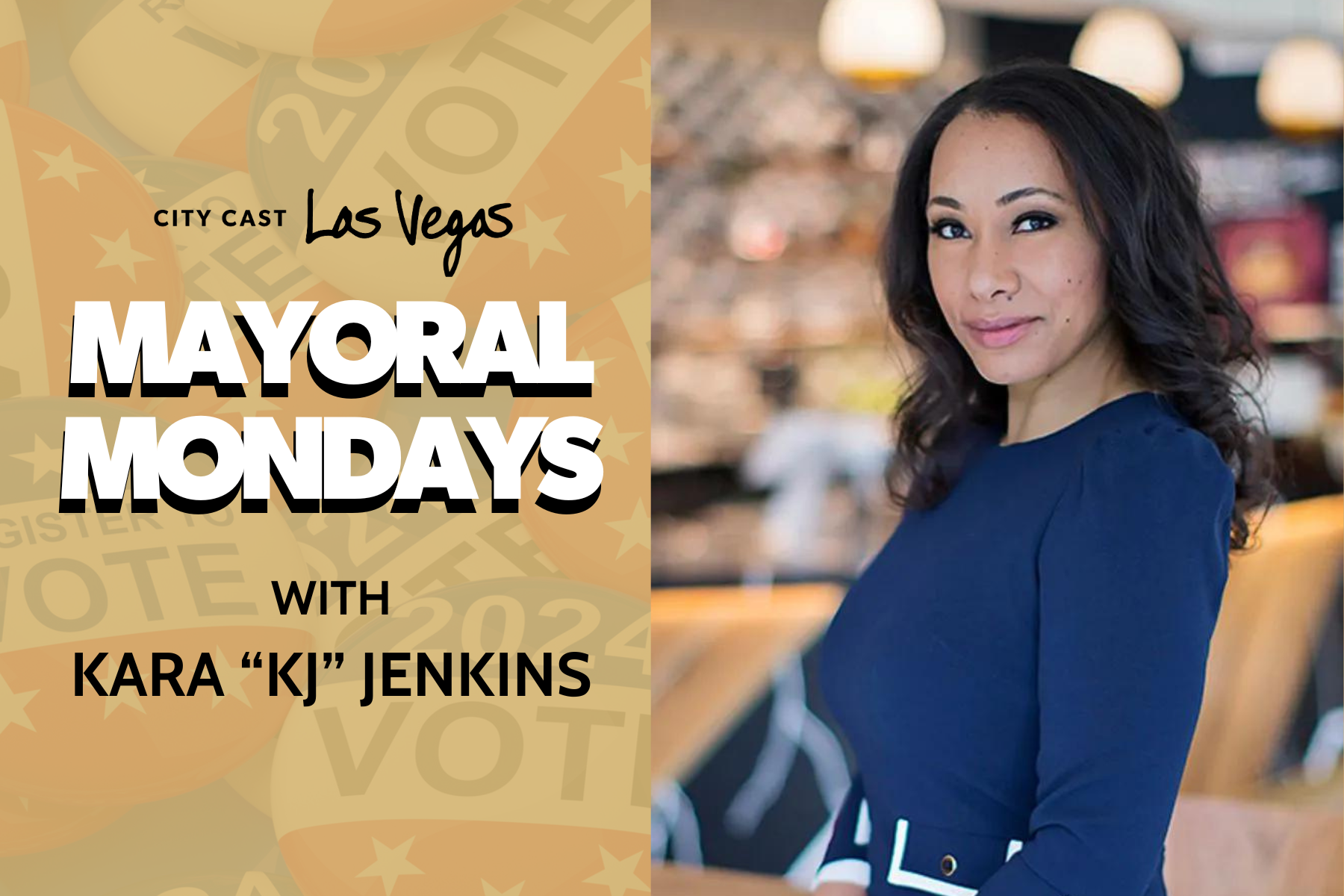
For our special series on the race for Las Vegas mayor, candidate Kara Jenkins sits down with executive producer Sonja Cho Swanson. Kara, or KJ, currently serves as the Nevada Equal Rights Commission administrator and has been a public servant for 10 years under Governors Brian Sandoval, Steve Sisolak, and Joe Lombardo. They talk about encouraging young voters, what the role should entail, and how she hopes to be a mayor for everyone.
Find more of our coverage on the Las Vegas mayoral race here.
We’re on social media! Follow us @CityCastVegas on Instagram. You can also call or text us at 702-514-0719.
Want some more Las Vegas news? Then make sure to sign up for our morning newsletter here.
Learn more about your ad choices. Visit megaphone.fm/adchoices.
Want to follow along while you listen? Here's the episode transcript.
Disclaimer: This transcript was auto-generated. Please excuse any typos or confusion.
Sonja: You've seen the billboards, you've seen the flyers, the Las Vegas mayoral race is in full swing. And today on City Cast Las Vegas, we're continuing our mayoral coverage. I'm talking with candidate Kara K. J. Jenkins today. Kara, Kara is an attorney who moved to Las Vegas to work in Equitable Healthcare Access.
She was then appointed by Governor Sandoval as the administrator of the Nevada Equal Rights Commission, an appointment she's continued under Governors Sisolak and Lombardo. Thanks So today we're going to hear from Kara about her platform and her vision for the city of Las Vegas.
It's Saturday, May 11th. I'm Sonia Cho Swanson, and here's what Las Vegas is talking about.
Okay, so let's start off with the, the easiest question, Cara. Tell us who you are and why you're running for mayor.
Kara: Okay, I think I can, I can answer both with, with certainty because the latter I've been asked pretty much by every person, my parents, myself, why, why do I want to be mayor, but to all your viewers, hey everybody, City Cast, Las Vegas, my name is Cara Jenkins. My friends call me KJ, please feel free to call me KJ as well.
Uh, I live in Las Vegas. I live in the urban core. I live in ward three, uh, the historic Huntridge slash arts district area. I love it. It's my home. Um, I bought that house about two years ago and, um, I love my neighbors and I love my community and I love Las Vegas. And I am currently, as you know, serving under criminal justice.
Governor appointment, but my wanting to be mayor, um, has a lot to do with you to do to help the locals because I am one. I'm someone who moved to Las Vegas over 14 years ago and just couldn't leave. Not that I really wanted to. Once I came to Vegas, I realized that if I worked really, really hard, Sonia, that opportunities would be presented to me.
And I really want to keep that momentum going. Since about 2020, I'm not really seeing that movement. There's A sentiment in the city amongst us locals that all the great things that are happening, and they are great, we have, you know, the building of the Allegiant Stadium, we've got so many more sports and entertainment options coming our way, but we still feel like a lot of the locals, we still feel like we're in the shadows.
of everything great that's happening here. That somehow the revenue that's, that should be coming to us locals and quality of life, it's still really, really hard to, to put a tank of gas in your car, uh, or put gas in your, in your car. in your car to pay that rent or pay your bills or even to have a sentiment of happiness.
I know when F1 was here, I was in traffic for a good 30 minutes just to make a five minute drive to my house. Um, from,
right? So I'm just kind of wondering if others, Well, I am. I don't wonder anymore. I know a lot of us are feeling like, where is the assistance when we need it?
And so one of the things that I hope to bring, um, as your next mayor is a sense of relatable. Uh, understanding of what's, I have a heartbeat for and a pulse for what's happening in our community. I think, uh, what we see right now is we see people who are in City Hall who are very excited about all the great things that are happening, and they're sprinting to get on that red carpet too with the celebrities.
And I, I gotta tell you, you know, it's, it's fun to be fabulous, but not at the expense of innovation and making sure that, uh, That our, that our responsibilities as electeds or as local leaders or even in government as an appointee, that we're attuned to the needs of our people, that we're meeting those needs with technology, innovation, and concern and compassion.
And we're not making people jump through extra hoops to get services done.
Sonja: before we get into your platform and your, I would just want to back up and learn a little bit more about you because you're, you're relatively new to the Las Vegas politics scene
here. So
tell us
Kara: Oh, 1000%. I'm not a career politician at all.
Sonja: want to, and that's why we want to talk to you and learn more about, you know, your, your background and where you come from.
So tell us, what does the administrator of the Nevada Equal Rights Commission do? So what does your day to day look like in this
job?
Kara: Well, I'm going to keep it very high level because I'm not supposed to mix state time with my campaign efforts. That is something that's very clear. And so in that role, though, which is a very fair and beautiful question, Sonya, it's like, what do you do, Cara? Well, I've, I've been a government, uh, agency head for over 12 years.
I oversee an amazing team of public servants, of civil servants. I oversee budgets. I streamline in trying to get services to people. People. Um, we oversee complaints. We make sure people get a fair shot. I administer the law. I report to the governor. I report to the legislature. I do outreach and training.
I do education. Um, one of the roles that I really enjoyed before I was administrator for the Equal Rights Commission was I was also a lawyer. And that's a funky kind of word, but it really means it's like a cool word that says that you are the go between for people and government. So you help to explain what people's rights and responsibilities are, how they can access the government for help.
And how Not when we're talking about help, we're not just talking about handouts, we're talking about, Hey, you, you want to start a business or you need to know how to operate in a certain way so that you're in compliance with the statutes, the laws, um, I'm the one that explains it and breaks it down for you.
So I always have been a mediator after graduating law school, I really excelled in that. I really did enjoy helping people come to an agreement, especially when they were at polar opposites of, of, of just even coming together or just, they just were estranged. And that's a big part of my job now, too, bringing people together, um, at least in settlement when there is a disagreement.
Um, I find that we have, Sonia, a lot more in common than we don't. And usually when we have disagreement or there is Friction in relationships, or we are on opposite sides of debates, and there's a lot of them going on locally and nationally and just everything going on right now. Um, there still is a common humanity thread in those disagreements.
It's basically, it boils down to not being seen or heard. And the frustrations and the emotions, you know, when are just the symptoms of something that is deeper, which is we all have this human need to want to be heard and seen. We all want to live well. We all want to make sure that whoever we love, it's acknowledged that we can, you know, enjoy ourselves and have fun, but also work hard and see dreams come through fruition, whether that's through Starting a business or, um, being an entrepreneur or working for a company.
Everybody wants to be seen and everybody wants a fair shot. And so it's how do we get people who are from opposite ends of the spectrum together and aligned. And being a mayor, I can get people around, regardless of your political party or affiliation, I can get you around the fact that you are Vegas.
There's this huge misconception that Vegas is a transient town and we don't have community and that's just not true. Um, we are some of the hardest working, uh, independent, sassy, feisty people that you'd ever want to meet, but we'll love our pets religiously, um, and take care of our neighbor. But don't tell us about our guns.
Just don't. Vegas is a very interesting town, but there's so much.
Sonja: Yeah.
Kara: We are from all over, but we've all decided that Vegas is going to be home for us. And so the mayor needs to make sure that she represents everybody who calls Vegas home. There should be a privilege of being a Las Vegas resident and local, and the mayor's the one that champions that privilege and says, Hey, if you do business here, you need to run it down to my business here, uh, off of Main Street.
Or there's a small business that needs access and Put them in a vendor or help them be a vendor or have a food truck outside of your stadium or one of your events. That our locals get discounts and tickets and opportunities to work huge, large scale events. Um, that we have opportunities for people that live here.
That should be a perk. It should be a perk.
Sonja: talk a little bit more about your campaign. I mean, understandably, new politicians, uh, are going to have a harder time breaking through than some more well known names, as we know. Uh, there are some, established politicians who are already in the race.
What do you think that you bring to the table that some of these more established, names don't?
Kara: Well, that's a great question, Sonia. I think I bring myself and the fact that I'm not a career politician. Um, we've talked to so many people, I've knocked on doors and I've actually had, you know, focused meetings and talked to folks. And really just before I decided to run, I, I took a, I took a year to explore this and see what it was.
If what I was feeling as a local was resonating with others, because I don't want to make any decisions that are just, um, based on selfish ambition. I am a true public servant and that I want to fix, I get happy when people win. And it just has to be who you are. It has to be in you. Um, I can't escape it.
It's how my, my family's raised me. It's who they are. It's just who we are as people. But, um, what I'm trying One of the things that I think separates me is that, and I think it's a distinguisher, is that yes, I may not have the name recognition yet, but word is spreading. And I don't want to just keep recycling out in elections and campaigning just because I don't know what else to do with myself.
I actually have an established career. I am an experienced mediator. I've worked for four governors, different parties. I am a trusted, respected Public Servant. But what I want to see is, I want to see some things happen for our people, um, so they can live out their dreams. Because it happened for me when I was here, but I'm seeing even now for myself, Sonia, that paying bills is tough and it shouldn't be that way.
Um, it just shouldn't be. Not when we have so much opportunity here. And I want us all to have an opportunity to live well and live out our dreams. And I just think that one of the things that kind of gives a new perspective or, uh, When you're entrenched in politics for so long, I think it becomes routine and rote.
For new blood and to pass the torch, you have to have someone who's got new ideas, who's innovative, collaborative, respects the past, but can trailblaze the future. And that's what I think I can do and offer.
Sonja: Well, what do you say to the argument that, you know, uh, being an established name in politics means you also have the experience? I mean, for example, two of your opponents are on the city council, and the mayor would, uh, also serve on the city council. So, I mean, how do you speak to that experience that these other candidates have?
Hmm.
Hmm.
Kara: I speak to it as that if they're currently on city council right now, why are they still running on platforms for things they can fix right now? So, and one of the things that I am good at doing is walking and chewing at the gum at the same time. I mean, I didn't know what an ombudsman was. I didn't know anything about law school. I certainly went to Harvard and, and did very well. It's, it's not, it's the skills that I have that are inherent to working hard and being successful and collaborative that make for a good mayor.
Also my youth and energy, and that I'm not kind of jaded from this political system because it can, I've seen it happen with a lot of politicians. It becomes a cycle and it can really get to the point where now you're beholden to your stakeholders and donors and you can't even, Be who you wanted to be.
I don't have any of that baggage. I have nothing to lose, everything to gain. It's really their race to win and not have me take it away from them. The reason I'm running Sonia is because I am a resident who's lived here, who's worked in government, who's made solutions happen, who, who is collaborative.
And I want to try to help people, um, at the local level, my neighbors, myself. Um, and it doesn't really, I'm not really offended by that or think of that as a criticism that I'm, I'm not a career politician. I actually think it's a compliment. I think we need more just local people here who have a pulse and a beat and can understand what the everyday person goes through.
I feel like That's what's missing in City Hall is someone who is of the people for everybody. Now, I'm a black woman, I'm a woman of color, and I'm educated and I have my own lens, which surely I will bring to office. However, I, I work with people, I will work with whomever. I'm not beholden to any political party or to any particular funder.
I, I, I, my stakeholders are the people that put me in. I will never forget that and we lack that right
Sonja: MUSIC
speaking as stakeholders, I mean, I think probably out of all the candidates that I've observed, I think you're the most active on Instagram.
And,
uh,
Kara: Thank you. Yeah, we have a very good social following. And yes,
Sonja: presence there. And, and I'm, I'm wondering, you've
Kara: thank you.
Sonja: about reaching out to younger voters who maybe feel like disillusioned by politics as usual.
I feel like I've heard that a lot from some of my younger friends. Um, so a couple of questions, you know, is this your demographic? And then also, how do you get them out to vote?
Kara: Well, we are talking to them, um, and, uh, being 45 years old, I, I, I, I'm a millennial slash ex, I still think I have a, I have a good, um, understanding of kind of what some of the struggles are for even the younger generation of voters, all the way down to 18 years old, and they're living in a world that, uh, Uh, is filled with turmoil and they are struggling and they don't understand it because our country is so well resourced.
And one of the things I like about young people is that they have, they've not been jaded by the world or life yet. They're very aspirational. As I sit here at UNLV, I'm just, I see all these young students here and I also, um, do a moot court judge panelists at the, the law school. And I work with young lawyers too.
And, um, My campaign lawyer was my intern. Um, and so now he's working for me. Yeah, so it's, it's always about passing the torch. And so that's what I tell young people. I said, don't get disillusioned with it. Your voice is so strong when you vote. I mean, it's very strong when you march and you peacefully protest because you have something to say that's your First Amendment right.
Um, in fact, that's actually, Sonia, why I went to law school. I wanted to understand how these laws were created and, and who they benefit. And I felt like there's really, there's a lot of power in knowing what your rights are. So that was what really inspired me to go study law. But now that I talk to young people, I tell them, yes, you can march, but you need to vote.
That is how your voice is heard because entities look at voter turnout. I have someone on my team, Sonia, who is studying right now, looking at trends and data. And you know where all the resources go? To the places where people vote. That is a driver like no other. And so to get people inspired, it takes a little bit of, um, you know, you have to go to meet people where they're at.
I, I'll say this, there's a lot of established career politicians that are so arrogant when they walk in the room. You can't approach them. They, you feel like you have to kiss the ring. I've experienced it myself, and I'm at the highest level of government out of all my candidates. Who cares though? I mean, honestly, I say that with all respect.
All my appointments have meant the world to me. I'm so honored to have been accepted and approved and, um, in, and. And tapped into for help. But when I, when I say who cares though, it's that it just doesn't matter your title. Your title doesn't entitle you to be any kind of way to anyone. We're human beings first.
And so I think young people really resent that. They like real. They want someone that can come and talk to them and meet them where they're at. Um, that's what local government does. It's, it's, it's an accessibility factor that I think is missing, but I think that's why we're seeing so much engagement on social media.
The comments and people saying, you know, Kara's my mayor and this is who I want to represent me. It, it humbles me. It's not, it's not lost on me that I am representing the hopes of other people and that I need to always constantly check myself. And I do have, you Great, great counselors and family did around me.
They have a truth. They tell me about myself to make sure that I'm doing everything for the right reasons. And I'm putting people first, but it's so inspiring to see people get excited because when I was in college, I was running voter registration drives in my college campus. I was trying to get people registered to vote when I worked other political campaigns.
That was a big part of me wanting to get the word out to certain communities that were more marginalized, that didn't have access. Because I think access and being seen is a part of this American gift that we are American. We should have access to our leaders. We put them in office. They should be accountable to us.
And if they're not, new people have to come along and new people should have an opportunity and I'm grateful for this platform to speak to you today as a new politician.
Sonja: Well, as promised, I'm coming back to the issues. What do you think should be the top priority for the new mayor? Whether it's you or someone else, what should be the top priority?
Kara: Well, the top priority should be what's lacking, and that's accessibility and being available for more than ribbon cuttings. That's the first thing. Um, it's someone that, um, exudes confidence, strength, and an unwavering dedication to her people, who lifts up her
Sonja: in concrete,
Kara: like me.
Sonja: details?
Kara: That looks like me.
That looks like what you're seeing on social media. I'm at every event. I'm managing, um, my state role and my personal time off responsibly. I'm focused. I try to be present. Um, I, I, I get back to you. I mean, even some of the simple things that we learned about being polite and having etiquette, saying hello, having emotional maturity to understand something that if someone disagrees with you, you still have to respect them.
And so I, I want that to be the first thing that people see when they see me. And I want people to say, That's my mayor. I'm very proud. That's Kara. I didn't agree with, with her on this, on this topic, but however, she represents me. She's good. I'm proud of her. I, that's what I want. And then I want people to say, I absolutely agree with her because she's talked to me.
And I understand, um, where she's coming from and that's my mayor. That makes me happy because that's why I, you know, That's the sacrifice for most candidates. That's at least my sacrifice to make sure people feel seen and that I'm their voice. Then it's tackling some of the issues that we all know too well that have been going on for too long, um, like homelessness, not really having a collaborative, um, Task Force to, with non profit, with non profit and private entities to try and, and health care workers and drug counselors, um, to really get people the help that they need to move them from these tents, to get them resources, them and their pets.
Um, I, we have so many great non profits like Street Dogs that gets, you know, the pets of homelessness, uh, homeless folks, um, taken care of because those are a lot of, for a lot of times those are the, those are the family members. Thank you. of people who are unhoused, but getting them into a safe place, especially our veterans, women, and children, off these streets, um, access to water, um, all those things that are just human dignity efforts that government should be responsible for.
We need to tackle that.
Sonja: let's talk a little bit more about homelessness. Um, recently on Channel 8, you said you think the camping ban has been ineffective. So, as mayor, would you work to repeal that? And then,
what do you
say to
Kara: I don't know that I would repeal it. Yeah, I don't know that I would repeal it because we got to go to council and it's got to be brought up again as an ordinance, but it's time to work more towards it because the data shows that even since we had that ordinance put in place, homelessness has gone up.
We're just sitting here putting band aids over bullet holes. And so what's not happening is, and so what this ordinance basically does is it makes it. Yeah. It makes it illegal to quote unquote loiter outside of a business and I understand that because our businesses need protection too.
Um, but it doesn't stop people from coming back. Like for instance today, I was talking to um, a business owner who said, um, you know, they have someone that keeps getting arrested, they come out, they vandalize again. They get arrested, they come out, they vandalize again. Another business owner, uh, said that, uh, right off of, uh, Main Street in Charleston, that's kind of a hub for people who are coming out down from Summerlin.
And a lot of transient folks kind of hang out there, but, you know, they'll vandalize the locations and it, it makes people feel uncomfortable and it, uh, Drives away business. So we've got two needs here. Um, we've got the needs of businesses to operate their businesses where they don't have it deterred because this is their dream, their blood, sweat and tears.
And then you've got people who have literally nowhere to go, um, or they're arrested or they're put in jail and released. to go to shared beds where, honestly, a lot of women and children and folks don't really want to do shared beds because it puts them more in harm's way. And so collaborating, um, with, uh, other cities and seeing how they're, they're doing it like L.
A., they've done a great job with getting rid of, um, and tackling, some of the, um, issues. Tents, the tent cities, through what they call, it's Mayor Bass's Project Inside Safe, or Safe Inside, it's one of the two, but it's like a tiered attack of addressing homelessness, and you start with the tents, and the city basically buys property and runs property where people can go in and have a quiet A place to sleep, a shower, uh, a location and it's temporary housing, but the city owns it and operates it.
But guess what? Now we've got a location where we can send social workers there. Sonya, we can send, um, counselors there. Drug abuse counselors. We can get people IDs.
Sonja: is, is this a kind of a redirection of the courtyard then? I mean, do you see the courtyard, which is the City of Las Vegas current solution, uh, I, I guess you could call it a shelter, you know, um, is, is that a solution that you'd want to continue working on? Would you try to reform it? Like, what, what, what would that, what would the courtyard look like under your tenure?
Kara: would actually talk to the people that have to work there because I've actually volunteered at the, at the courtyard,
um, and, uh, those people work incredibly hard. Um, and they need assistance and they need support. They need help. And, um, I've been there. I've, I've volunteered there, um, at the courtyard. And it's just, that's just not going to be enough.
And then putting it right there, uh, off of Ward 5, in Ward 5. It's putting one ward and just, you know, They're having the burden of all of this when homelessness is a shared responsibility, no matter if you're City of Las Vegas or you're City of Henderson or City, Boulder City, um, it should be a shared responsibility.
So I'd also work with other mayors on how we get together and collaboratively look at, um, tackling homelessness. With the City of Las Vegas, Mayor Tu, Mayor Pam, she's amazing. I really, really like her a lot. Um, but it's just, homelessness is not going to be something that the City of Las Vegas or Ward 5 should have to just, you know, Tackle or care complex has to just tackle.
It's got to be a collaborative
effort. Mm hmm.
Sonja: So if I can just shift gears real quick, um, talk about Badlands real quick. That is an anvil hanging over the head of the city. Uh, some observers have said it could potentially bankrupt the city. We're on the hook for, I think at this point, over 250 million in court settlements.
Uh, so as, as mayor, what would your move be? Do we just move to settle? Do we continue the court
battle? You
know, what's,
Kara: we should really push for settlement as, uh, thanks Sonia. That's, it is, uh, for the viewers that don't know, I don't know if you want to explain that, the bedlands issue,
Sonja: can do it super
quick. Yeah.
Kara: sure. Okay, so a developer was, uh, told that they could develop, then they told they, they told, they were told they couldn't, and now they're suing.
Because they want to develop. And it's a lot of money. It's a litigation. And it's your taxpayer money that's going to have to pay this developer that was told he could build and now he can't. And so what we're looking at is, uh, bankrupting the city. That is, it's a scary thought, but you know, I think that we'll push for a swift settlement and then we'll have to take lessons learned.
And I'm not on city council right now, um, but my two opponents were very much involved in those negotiations and again, I'm here because people want change. And, uh, I'm not here to say it's any one person's fault, but we need to do due diligence when it comes to representing our people. Again, we're, our voices aren't being heard here.
Um, our taxpayer dollars, the revenue that we get for the city is to make better parks, build roads. These damn traffic cones are everywhere, Sonia! It's,
Sonja: it's,
our state flower,
Kara: it's, it's it's It is our state flower. It's, it's, it's about living well. It's about, um, grants and opportunities for small businesses, but we're paying a litigation settlement though?
Y'all, it's really important you vote. And this is what I tell young people. You have to vote on June 11th. You have to get the leadership that represents you.
Sonja: let me, let me ask you this. So, you know, we talked a lot about the things you hope to see changed in the city, but perspective, what do you think the city of Las Vegas is doing right, right now?
Uh
Kara: Well, I really like their social media arm. Um, I think that we do a really good job of giving keys to the city, ribbon cuttings, and showing businesses at the beginning that we're there for them. Is that nice? But what we can do to better is streamline the application and permitting processes, um, for, for new business owners, help explain what it is to start an LLC and run a business here, um, make it easier to get liquor licenses, embrace legal cannabis.
As a legal drug here, it is legal. Um, expand the reach of, of what we can do here to be an innovative city and current. Um, again, it's, we feel like we're in the shadows of everything great here. We need to push that down to our people, but I will say that the City of Las Vegas, um, It's still super fabulous and I just love the heart of Las Vegas, the business owners that I'm meeting and my friends who are business owners here.
But the city of Las Vegas does a very good job of, um, social media. So I would say that they're workers. The city workers are pretty awesome. I, I've, I know a lot of them. I've met them and they're hardworking public servants, civil servants and I get that because I'm one too. But I, I, I do like the, um, the social media aspect, how they're trying to make, um, things more noticeable.
Explaining things to people. Parking and festival times and when things are, when streets are closed and roads are closed. That's, that's, I really like that.
Sonja: Alright, shoutout to City of Las Vegas Instagram. Whoever's running
it, you get a shoutout
right
Kara: Yes, yes, a social media team for City of Las Vegas. You're doing a fantastic job.
Sonja: Here we go. Okay, so last question for you, Kara. We get to the fun one. As mayor, yes, as mayor you can pretty much summon anyone you want for a long lunch. You're gonna call them up and they're gonna be like, yes, I want to have lunch with you. So who is the first person that you would bring up to have a long talk about the pulse of this city?
Kara: Mayor Goodman.
Sonja: Oh, you know what? I'm sorry. I should have said the rules are, uh, no Goodmans and, uh, no City Cast employees.
Kara: Okay. Well, I would talk to her about what she would, I just would want a transition, a transition conversation and things that she had hoped for, things that, you know, just, I would give her that respect because she is a beloved figure. But now that I know the rules, who, this is a great question. Who would I call, um, to have a long lunch with?
I would probably call, and they would come.
Sonja: They would, you're guaranteed, and they have to be alive to be
fair, but they are
Kara: sure. Okay. I would want to talk to Melinda Gates.
Sonja: Ah.
All
Kara: her philanthropic arm and how she is using money to get other women elected and how she's looking at other ways of helping to innovate more, way more rural communities, but then talk about solutions that she's coming up with, especially when it comes to green energy.
Not that I am super knowledgeable about that, but I want to make sure we have a sustainable city and I want to talk to folks who Who know about, who know people who know people so we can get this water solution. You know, I could work of course with water reclamation and our, you know, all of our respectable agencies, but I really want to get to the, talk to the people who are the big thinkers, who have access to more great thinkers so that we can bring it here and then train our people to do the jobs.
So it'll probably be Melinda Gates. I'm really curious about her. I've been seeing her do a lot of great things, um, and I, it would be, it would be her. Melinda. That would,
I'd have a really long
Sonja: heard, Melinda, you've heard the call. Please come to Las
Kara: Yes. Yes, she can come.
She's welcome.
Sonja: she is. Yes. Kara, thank you so much for spending the time with us. This was a fun conversation.
We appreciate It
Kara: Thank you so much, guys.
Sonja: That's all for today here on City Cast Las Vegas. If you enjoyed the show, hey, go tell a friend. Rate the show. Leave us a review and subscribe to our morning newsletter. We'll be back soon with more news from around the city.
Take care.