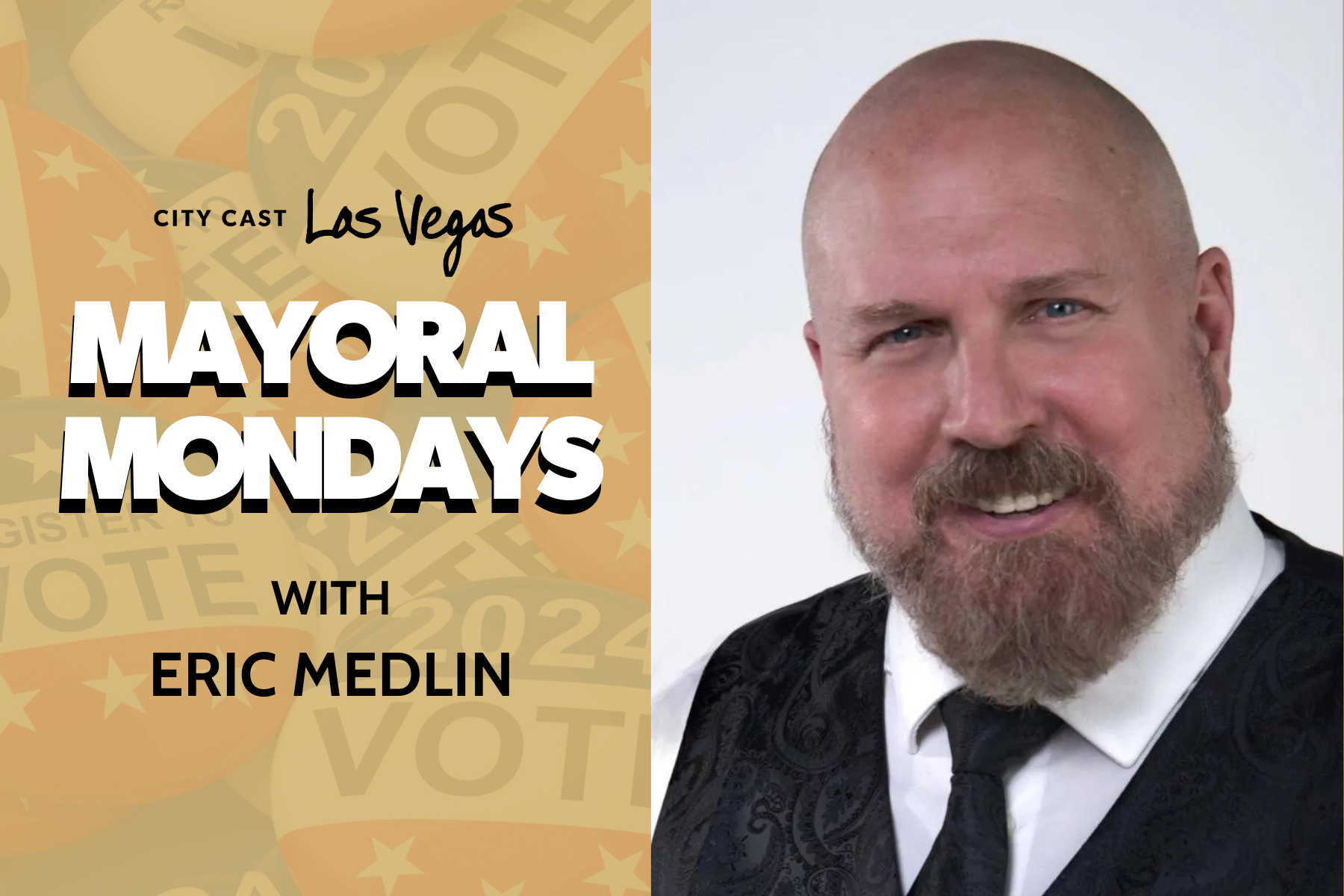
Our special series on the Las Vegas mayoral race continues with small business owner Eric Medlin. He sits down with co-host Sarah Lohman to explain how helping unhoused people get mailboxes at his store prompted him to run for mayor. They talk about housing, education, and his unique approach to his campaign.
Find more of our coverage on the Las Vegas mayoral race here.
We’re on social media! Follow us @CityCastVegas on Instagram. You can also call or text us at 702-514-0719.
Want some more Las Vegas news? Then make sure to sign up for our morning newsletter here.
Learn more about your ad choices. Visit megaphone.fm/adchoices.
Want to follow along while you listen? Here's the episode transcript.
Disclaimer: This transcript was auto-generated. Please excuse any typos or confusion.
Sarah: The June 11th primary is coming up fast and furious, and we're continuing our coverage of the Las Vegas mayoral race.
Today on CityCastLasVegas, I'm talking with mayoral candidate Eric Medlin. Eric is a U. S. Army veteran and a small business owner. He says problem solving is his strongest skill thanks to his Army experience and 27 years working in information technology.
Eric does not call himself a politician. Instead, he says he's running on a platform to bring a common sense approach to the job.
It's Saturday, May 18th. I'm Sarah Lohman, and here's what Las Vegas is talking about. Eric, welcome to the show. Please tell our listeners who you are and why you're running for mayor.
Eric: Well, thanks. Nice to meet you, Sarah. Uh, well this kind of was on a whim. What was happening was, um, there was a, a, uh, what was called the first international conference on homelessness down at UNLV. And it was right down the street from our store. I own a mailbox store. And we had this idea cause we have a lot of homeless people that have mailboxes with us.
And we thought, you know, That's a lifeline for them. They have a, that's a way that they can get their documents, they can get their medication, but a lot of them don't have enough money to pay, and they're always coming, you know, in, and they're late, and we said if we could get them subsidized, like little houses. That'd be a great idea. So we bought tickets and we went down to this international conference on homelessness, the very first one, mind you. I've never had a second one, by the way, but you go down there and everybody listens to our idea. I said, yeah, if we could get these little mailboxes subsidized, you could do it to all the mailbox stores all over the United States. And they said, great idea. The VA said, great idea. And not one of them called us back. And I really got mad about that. I said, that's horrible. I said, I was telling my, my partner, Kenny, I said, business partner, I said, if when, when they have the mayor thing, I'm going to run for the mayor. I swear, I'm just going to solve this problem.
And so I decided to run and that's where I am now. I'm not a politician, but I'm somebody who is tired of the usual, you know, just somebody's just saying something to say it and glad handing. Cause if all the politicians were there and nobody's, nobody did anything. It's just, they're just talking a talk and nobody's doing anything about anything.
Sarah: You know, Eric, this is a really exciting place to start because of course, homelessness is a big topic, uh, with the candidates in this mayoral race. it seems like maybe being a veteran, you have a lot of empathy with veterans who are homeless. but other small business owners say that homeless encampments are affecting their livelihoods.
So what is your stance on the city's camping ban? Mm-Hmm.
Eric: Well, see, the thing is like, okay, so I'm literally right in the heart of the, I'm in the worst part. It's right there. Maryland Parkway, Swenson. Well, they renamed Swenson to try to liven it up by calling it University Center Drive now. But there's a park right there. It's just drug addicts are always in the park.
You have homelessness everywhere. They're in camping there. see the problem is, is everyone's going to try something, but they're not, they're not doing a, I guess what it is is the problem is much bigger than the solutions that are being used.
Sarah: Mhm.
Eric: encampments and telling me you can't camp and stuff that solves none of the problem.
The problem is way bigger and it's going to be able to cost a lot of money in the, in the, in the immediate. future, but in the longterm it actually trails off. So what you need to do is you need to actually house the homeless. It sounds antithetical, but you give them a house so they have a place to start from.
So now they're, they feel secure. Basically like dorm rooms. You'd give them dorm rooms. That's a place where they can start from. Then they feel secure. And those who are going, you're going to have drug addicts. You're going to have people that just are going to game the system and just want to live in these places for free.
But there's people that will get back on their feet immediately and they'll be able to move out of these dorms and go and go to housing. And then there'll be other people who will not even get in the system because once these people are moved in and they're all off the street, they're all living in housing.
Now, again, it's going to take years to build the housing for them, but you're going to have to do this. It's, it's the only solution. They're doing it in Finland. It's, it's working like a charm. And what they do is, there's no homelessness on the street. And when they see a homeless person, they go and they say, come here, you're going to come here and you're going to stay.
Because then that, that frees up a lot of resources. I know I'm kind of talking in tangents here cause that's the way, that's the way I talk. It's just, it's a tangent
Sarah: following. Yeah.
Eric: But basically, so you get them in housing, the ones who are addicted to drugs, you start trying to rehab them. It's not going to work.
Some of them aren't going to ever get off the drugs, but they're in a house and they're safe and they're off the streets and they're not using resources like ambulances and stuff to go to the hospital two and three times a month. And over time, You know, and we're talking generations. We're talking, you know, probably 30 years out, you know, they will have, you know, unfortunately, you know, they've passed away or moved on or, you know, just aged out of the system, but the new people coming to the system won't be as many.
And eventually it just trails down and the number of homeless won't be as much because you're grabbing them immediately before they fall through the cracks, saving them and they move on. But right now, we're gonna have a whole bunch of people that probably we can't save, but we're gonna get them off the streets in a, in a housing.
Eventually, we won't need the housing because again, it will just age, the system will age them out, if that makes sense.
Sarah: I'm curious. What is your stance on the city's current homelessness solution, the Courtyard Homeless Resource Center?
Eric: Again, it's just a band aid on something. The homelessness has increased since we've had it. It's, you know, it helps a few people. Like I said, the problem is much bigger than that. Unfortunately, it's going to cost a lot of money. And every city in the world is going to have to do this. And it's just, but see, it's people think of it immediately.
Oh, we're just going to give housing to people who don't deserve housing. They're just going to be freeloaders. Yeah. The initial, the initial ones coming in are going to be freeloaders. Yes. We're just gonna have to accept the fact, but it's going to cost us less money a year to have them freeload in an apartment building than to freeload on the streets due to crime, uh, destruction of property, uh, just, you know, medical resources, uh, the police, all that.
It's going to cost. So even if it costs, I think the numbers in Finland, they were talking, it's like, It was 30, 000. I'm actually I was watching a video here in California. It was 30, 000 a year and once you started housing them They only cost like 1, 300 Because they're not using up resources. It's just freeing up money that can be used for other things in the city So yes, initially it's going to be very expensive But it pays for itself in the long run and eventually it trickles down to where there's the the cost is minimal
Sarah: So, let's bring it back to you for a moment. where are you from originally and what brought you and your family out to Vegas?
Eric: Um, well, I'm originally from, uh, Washington, DC, right outside the DC area. I was born at Bethesda Naval Hospital. Now it's, uh, Joint Base Walter Reed or something. It's where the president goes when he's sick. uh, you know, I worked in, I actually worked at the National Institutes of Health, which is right across the street back in, uh, the nineties when Dr.
Fauci was the head of, uh, uh, NIH. Joined IT there when they were first starting their IT department. and then it just, uh, On a whim, I just, you know, I had this notion because I was doing IT. I was like, Oh, Las Vegas has got lots of glitz and glamor and lights and stuff. They must have lots of IT. It turns out they really don't.
It's like MGM properties has like one IT room that pretty much serves most of the properties. They have like, you know, little, offices over in each building, but for the most part, they're big IT centers in one location. They probably don't want me saying that though. Um, but yeah, so I just came out here thinking there was a lot of opportunity in IT.
Turns out it really wasn't. But, you know, I ended up falling in love with the city. I've been here since 2007.
Sarah: Eric, to me, it seems your whims are things that other people would consider massive life of peoples. But I, you know what? I, I like that. I'm into it.
Eric: Yeah, I just, uh, I like change, a change of pace, something like that. Because I actually moved, well, when the economy collapsed back in, what, 2009 was it? Eight or nine? Here when we had the housing crisis. I was like, ah, I'll pack it up. And then I went back to D. C. and I was there for about a month. I go, ah, now I'm going back to Vegas.
I was like, you know, I just fell in love with the
Sarah: Oh, it's still your heart. So tell me more about the work you've been doing over the last couple of years. Are there any accomplishments in particular that you're proud
Eric: I said, I became a small business owner after the pandemic. Um, the housing market went through the roof, so I was able to sell my house and buy into a business. Uh, so yeah, that's pretty much been occupying my times for the last couple of years. Like I said, I mean, that's where I got interested in doing all this.
Like we were talking earlier, just, we have a lot of homeless people in our area and I see it every single day. And it's like, there's nothing being done. Um, nothing seems to be working. Uh,
Sarah: hmm.
Eric: you know, Again, like the mayor doesn't really have a, you know, they just have the mayor of Las Vegas has a big megaphone.
It's a big bully pulpit. So I can present ideas. I've got a bigger voice than most mayors. Like the mayor of Poughkeepsie, no offense to Poughkeepsie, just doesn't have that same megaphone. You know, it
Sarah: All of our Poughkeepsie listeners are furious with you right
Eric: Yes. I, and I apologize. I will make it up to you, Poughkeepsie.
Sarah: don't think anyone listens from Poughkeepsie. Don't worry. Go
Eric: Yeah. Well, you know, but there's always that one. There's always one. Somebody's going to mention it in the comments, you know, it's coming. I expect your cards and letters
Sarah: Ha ha ha
Eric: and your tweets.
Sarah: Mm hmm, mm hmm. Go on, sorry to
Eric: so yeah, that's it. I mean, that's, that's basically what I've been doing for the last two years. It's just, you know, seeing, seeing what's going on and nothing's changing. It's only getting worse, you know, cause I was, I was not here during the pandemic. I got stuck on the uh, island, the side pan.
'cause I went to visit a friend and they've canceled my flights. 'cause you, you had to fly through Japan and they said, no, you can't come here . So I was stuck in paradise while the, while the, while I come back. But when I got back homeless, I said almost doubled it seemed. I mean it was, it was crazy.
but you were asking me what I was doing for the last couple years and that was, you know, basically I. What got me excited about this, excited about this, I guess.
MUSIC
Sarah: Las Vegas, but what else do you think should be the top priority for a new mayor, whether it ends up being you or one of the other candidates?
Eric: Well, okay. Um, okay. So obviously schools, I mean, schools are just, I mean, if, if you, if you started from scratch, you would probably be higher ranked school, higher ranked school system than the one we have here in Las Vegas. And it's attributed to a lot of things. The main cause seems to be we're very transient city.
it's like people are just coming and going so quickly that the children aren't having enough time to, uh, you know, assimilate, but also it's the, um, again, we know it's bad. We know it's not working. Do, do we actually scrap it and start, start from fresh? I mean, do we, you know, we get with the, you know, the, the school board, do we get with teachers unions, um, the federal government and say, what, what?
Why is this not working? What, what is actually happening? I was listening to a woman talk on NPR the other night and she was talking about You have generational problems in the school system. You have parents that went through the school system that can't read. They got out of the school system, weren't unable to read.
And I'm wondering why is that a thing? Why would somebody get to a whole school system and have and read on a, you know, a second grade level? Well, they're not able to teach their kids to read. So now their kids are coming to school in fifth grade or I mean, um, in kindergarten at five years old and six year old, and they don't know how to read and there's no one to help them.
And then the teachers don't have enough time to teach an entire class how to read. Um, But now, so now it's generational. That's been going on for 40 years. So, you know, is there a simple solution? I think we have to be more targeted, but again, it's, you have to work with the system you have and improve the system you have.
So again, I like to solve problems as an IT guy, you know, you just kind of get thrown into the fire. Somebody, you know, the network's down and you've got to go, Oh, I don't know what happened. So you've got to figure it out.
Sarah: you know, like you said, the Clark County School District is run by a Board of Trustees that represents the whole Valley. So how would you, of Mayor of Las Vegas, how would you go about accomplishing improving our schools?
Eric: Well, you, you, you'd have, you'd have to get, I mean, you have to get everybody together. It's like, okay, I don't know everything. I'm not going to know everything. So you've got to get to the next people. It's like, what do I know as mayor? Okay. Me, what does Eric know? So I say, well, I know this, this, and this.
And I'll say to someone else, okay, what's your expertise? You get in here. Okay. Who else knows something about this other thing that needs to be done? And you get them all together. If it takes 50 people sitting in a room and each one has 50 different skill sets, we can eventually figure something out.
Okay. The problem is, is again, it's another thing. It's a band aid solutions, band aid solutions. Sometimes you just have to start over. It's, and people say, well, that's impossible. You can't, you know what? If you keep saying can't, you're never going to get anything done. So sometimes you just go, let's just do it.
You know, nothing else is working. Let's try something new.
Sarah: You know what? And on that, let's talk about, uh, another sort of more concrete solution that you're in favor of. you said that you'd support a form of limited rent control. Can you tell me what that would look like?
Eric: So right now the, the rent is so high and the mortgage rates are so high that people can't afford a house. You can't afford. An apartment and it's creating homelessness, but it's also creating stress on just regular families. They don't have disposable income anymore.
Sarah: Mm.
Eric: So we'd have to work with, you know, property owners and just in maybe just for a limited time, you know, until interest rates come down because, you know, their property values go up, property taxes go up, your mortgage goes up, your rent goes up.
It's, you know, all of a sudden until some of this comes down, You may have to give incentives through tax breaks or whatever it could be. You know, again, I don't know everything, but get a group of people in. What's, what's the thing, what can we do to get some of these rents down so that people can afford housing?
When you have seniors on the street that all they have is their social security and they're probably only getting 1, 200 a month, they can't get into a one bedroom apartment with that. I mean, it's almost impossible as you have, there are some senior places for people under over 55 that they're coming in about 900 a month for seniors to live in.
But you know, you find out you have to live with, you know, roommates, you have to have to get an extra job. Um, and this is supposed to be their seniors. Vets, the same thing, the veterans. Um, I said you have a lot of them that have, you know, mental, mental issues. They don't want to go to shelters because they can't, unfortunately, they can't drink or do drugs in the shelters.
But if they don't drink and do drugs, they start thinking about killing themselves. And it's, you know, that's the thing that's just, you know, so we have to house vets. Um, you know, they, they serve the country, you know, as, as a vet, I, you know, we don't want, I was saying, we don't want anything special. We don't want special treatment as vets.
But we don't want to have to jump through hurdles to get things done either. Just, you know, just make it an easy path. But that's the same with, that's the same though with anything here, and especially like at the hospitals, Medicaid, Medicare. take the government out of some of this stuff and just make it, just make it an easy path.
Um, so I
Sarah: you endorse a policy that enacts rent control for seniors and vets?
Eric: Yeah, I would. I would. Um, again, it's, you know, it's kind of up there with that, you know, that it's, it's the right thing to do. It just seems, you know, the people have served their, you know, the military served their time and hey, you know, old people have served, have served their country for, you know, until they were old.
It's like, it's time for them to retire and go out in grace, not to have to worry about where they're going to sleep at night.
Sarah: Yeah. You know, we've, we've talked a lot about the ways that you would improve Las Vegas, so I'm curious, what do you think the city of Las Vegas is doing right, right now,
Eric: Oh, Las Vegas is great. I mean, look at this. We got, you know, now I was watching, I was listening to one of your podcasts, uh, We were talking about, you know, the, what, what the mayor of Las Vegas, his job is and stuff and how that Oscar and, and Carolyn were upset that they didn't get a sports stadium in, in downtown Las Vegas.
Cause again, most people don't, like my friends, a lot of my friends can't vote for me, even though they say, I live in Las Vegas and I'm sorry, you don't, you don't live in Las Vegas city. But what Las Vegas does, right. It's like it, it's the entertainment capital of the world. It's, it's just an amazing place.
I mean, like I said, we've got this, we've got football, we've got, Baseball coming. That one, I see now, I'm a little bit on that stadium thing though. That's kind of, cause most cities that funded a stadium don't get that money back. It never comes back the way it's supposed to. There's some, there's one city that they, the stadium's outdated, they've torn it down and they still owe on that stadium. you know, these, these, these, The people that want the stadiums, they're billionaires. Kind of thinking they might have to pay for this, and we just paid for a football stadium. We're going to pay for a baseball stadium too, but again, that's really not my jurisdiction. Um, but I like that sports are here in Vegas.
I'm sorry, I'm going on the negative side of things, but you were saying what do I like about Vegas. Um,
Sarah: know, I mean, Carolyn Goodman had some opinions about that stadium too, so, I mean, as you said, you're sort of a, you didn't say mouthpiece, what was it? A, uh, megaphone for the city. So, you know.
Eric: The Las Vegas mayor is a megaphone. He has the bully pulpit, or he or she has the bully pulpit. And it's, you know, but Vegas itself is just, I mean, I love this city. And I would like to keep, I would like to keep continuing with what the, uh, the Goodmans were doing with, uh, vitalization downtown. It was a shame that Tony Hsieh died because he was really helping out with, with the properties down there and revamping them.
Um, so we need to get some more investors down there and say, Hey, look, we, it, it, it's important that we revitalize downtown because, uh, you know, mayor Goodman had it correct as it's, it's the core of the apple. If that's rotten, the rest of the city will go. And he said, you can't let that part go no matter how much you, you may want to, you can't let that part go because if it, it'll creep up to the strip eventually.
So you, you realize downtown. And that just needs to really be continued.
Sarah: All right, here's our fantastical question. Get ready. So as mayor, you can pretty much summon anyone you want to for a long lunch. So who is the first person that you would ring up to have a long talk about the pulse of the city? It cannot be either Goodman and it can't be me, Eric, although I know that you, you want to get my, my opinion on the pulse of the city.
Eric: oh, see, the
Sarah: Not, not the first person.
Eric: That's, so, uh, Hmm. See, the thing is, I know, I know this, there's this old gentleman, he lives down off of Maryland Parkway and he has a mailbox with us and he just, he knows everything about Vegas. He's been here forever. So, I talk to him every day, he just kind of gives me the, you know, the, the insight into what's going on.
He's like, I'll go and hand out flyers for you downtown, just give me some more flyers. So, you know, as far as he's the one, you know, cause he, part of him's, uh, he says, and it's, it's, uh, he likes the idea of rent control. So, and he actually liked my idea of just partial rent control. He doesn't fully agree that he'd rather have full rent control, but he thought partial rent controls there.
So, so much. I talked to him every day, but let me try and see if I can think of somebody else that, um,
Sarah: Yeah, I don't think you have to. I think that's great. Since he's already
Eric: yeah, it's, it's just, he's local. He lives here.
Sarah: lunch after you win.
Eric: Yeah. And you know, actually that's true. Oh, and I do have a, I do have a different thing that I'm doing with my campaign. So everybody's asking for everyone's vote.
Please give me your vote, but they're not earning the vote. I'm going to earn your vote. I am literally from now until November and walking, I've got to lose 61 pounds or 60 pounds, 60 pounds between now and November 1st. If I don't lose the weight, you can vote for my opponent. I am literally putting my body on the line to get this job as Mayor , but I need everybody's help to get through the primaries.
You get me through the primaries, I will definitely keep working till November 5th, or no, well, November 5th the election. November 1st was the date, 'cause it was six months from May 1st that I will walk to lose this weight 'cause I weigh, I swayed in at 280 pounds and at 278, I'm sorry.
Sarah: You're also going to be walking throughout the city as well.
Eric: Yes, yes, I, I, I'll walk through different parts of the city. Um, we'll start listing. It's like right now I just have to get used to walking. I have three, the reason why, another reason was I have three slipped discs in my back.
Sarah: Oh. Mm
Eric: So, you know, I have to, I have to start getting into this gradually, but yes, eventually I'm gonna start walking.
We're gonna walk all the way to City Hall.
Sarah: That's so cool. Well, I'll see you out there on these streets, Eric. Thank you so much for being with us today.
Eric: well, thank you for having me.
Sarah: that's all for today here on CityCastLasVegas,
And if you enjoyed this show, we have been covering this mayoral race for weeks and weeks to come, all the way through the June primary. So tune in and catch some of our other candidate interviews. And while you're at it, rate this show, leave us a review, and subscribe to our morning newsletter.
We'll be back soon with more news from around the city. Take care!